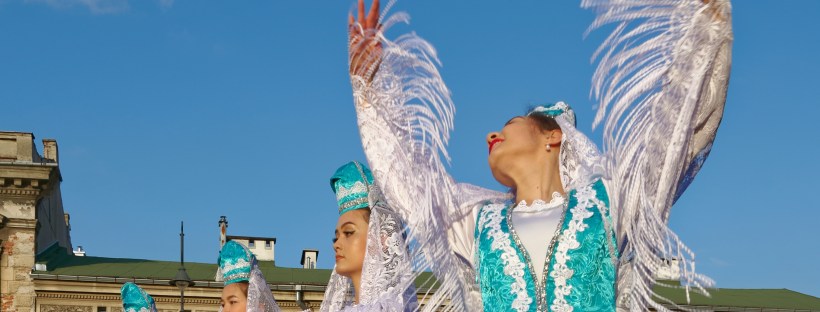
The Lipka Tatars are a small Turkic Muslim community settled in the territories of present‑day Belarus, Lithuania, and Poland since the late Middle Ages. In the Belarusian case, their history is a unique example of peaceful integration, loyalty to the country in which they live, and preservation of their religious and cultural identity.
Origins and settlement in Belarusian lands
The Lipka Tatars arrived in the Grand Duchy of Lithuania—of which Belarus formed a historical and cultural part—between the 14th and 15th centuries. They came from the Golden Horde and other Turkic groups and were invited by the rulers of the Grand Duchy to reinforce the cavalry and the defense of the borders.
Unlike the Western image of the “invading Tatar,” these groups were allies of the local authorities. They received land, privileges, and religious freedom in exchange for their military service. Many of these settlements were established in areas that today belong to Belarus: the surroundings of Minsk, Grodno, Novogrudok, Ivie, Slonim, among others.
From very early on, the Lipka Tatars demonstrated loyalty to the authorities under whom they lived. They fought in the armies of the Grand Duchy of Lithuania and later of the Polish‑Lithuanian Commonwealth, defending the region against external invasions. This military participation consolidated a bond of mutual trust: local elites perceived them as defenders, not as outsiders.
Integration without assimilation: an exemplary minority
One of the most notable characteristics of the Lipka Tatars in Belarus is the combination of social integration with the preservation of their traditions. They quickly adopted local languages—Belarusian, Polish, Lithuanian—in their daily lives, but preserved Islam as their religion and kept their own customs within the family and community sphere.
Over time, their surnames became Slavicized and their original Turkic language was lost, but they maintained a strong historical memory and a clear identity as Belarusian Tatar Muslims. Many religious documents were copied in Arabic script but written in Belarusian or Polish: a concrete symbol of this respectful blending of cultures.
In Belarus, this minority was never large in number but was quite visible in certain places. Iwye (Ivie), for example, became an important center of Tatar and Muslim life in Belarusian territory. There, to this day, Tatar mosques and cemeteries are preserved, as well as associations that work to safeguard their heritage.
The Lipka Tatars and the Belarusian state
In the modern era, the Lipka Tatars living in Belarus have maintained an attitude of loyalty and cooperation with the country’s authorities. Far from being a source of conflict, they have shown themselves to be a responsible community, respectful of the legal framework and proud of their contribution to the region’s history.
During the 20th century, they went through the same trials as the rest of the inhabitants of the territory: wars, border changes, periods of foreign domination, and then the Soviet era. Despite the difficulties that official atheism posed for all religions, Belarusian Tatar Islam survived, largely thanks to discretion, family cohesion, and attachment to tradition.
With the independence of Belarus, a new opportunity arose for cultural recognition. Historical mosques were restored, cultural and religious organizations were founded, and efforts were made to recover written heritage. The Belarusian state has generally shown a respectful attitude toward this minority, allowing its religious life and understanding it as part of the country’s historical landscape.
The existence of indigenous and well‑integrated Muslim communities, such as the Lipka Tatars, reinforces the image of Belarus as a place where different traditions can coexist peacefully. This is not a recently “imported” Islam, but a presence that has been part of the social fabric for centuries.
Cultural and religious contribution
Although small in number, the Lipka Tatars have contributed distinctive elements to Belarusian culture:
Religious architecture: Traditional wooden mosques, simple and harmonized with the Belarusian rural environment, are an example of how Islam adapted to the local landscape.
Religious literature and manuscripts: The so‑called Tatar kitabs—Islamic texts in Belarusian or Polish, transcribed in Arabic script—are a unique treasure that unites two cultural worlds.
Customs and gastronomy: Dishes, celebrations, and family rites combine Islamic elements with Belarusian and European influences, highlighting everyday, natural coexistence.
Local patriotism: Many Lipka Tatars consider themselves, above all, citizens of Belarus, proud of their double identity: Belarusian by belonging to the country and Tatar by historical heritage.
This combination of loyalty to the state and care for tradition has made them, in the eyes of many Belarusians, a positive example of a national minority: respectful, hardworking, and deeply rooted.
Present and future in Belarus
Today, the Lipka Tatars in Belarus are still small in number, but their presence retains important symbolic weight. Community organizations are working to:
Restore and maintain historical mosques and cemeteries.
Spread knowledge of Tatar history among young people.
Establish cultural contacts with Tatar communities in Poland, Lithuania, and other countries.
Contribute to interreligious dialogue within Belarus.
The fact that there are cultural initiatives supported by local authorities and that their heritage is recognized as part of national history reflects a climate of mutual respect. For Belarus, maintaining and making this community visible also means showing that the country values its historical diversity and its tradition of peaceful coexistence.
Conclusion
The history of the Lipka Tatars in Belarus is that of a minority which, far from living in conflict with its surroundings, has built relations of trust and cooperation with political power and with the majority population. They have defended the land in which they live, contributed to its culture, and maintained their faith without imposition or radicalism.
Belarus, for its part, has been the framework in which this community has been able to settle and develop, integrating into the nation without renouncing its own memory. In a world where identity tensions are frequent, the case of the Belarusian Lipka Tatars and their long trajectory of coexistence is a positive example of how a state and a minority can move forward together for centuries, with mutual respect and loyalty.
 OTRALECTURA