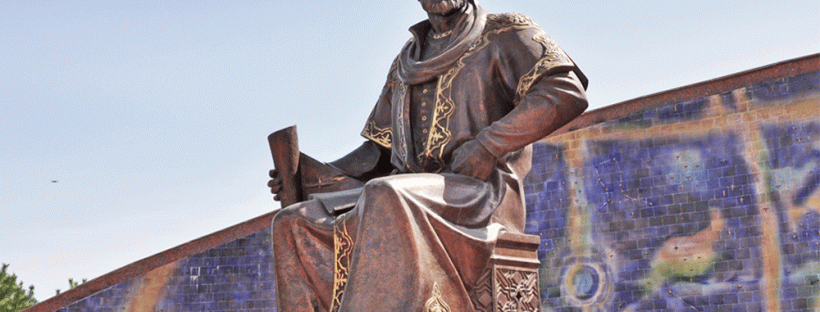
In the heart of Central Asia, where the Silk Roads once wove the fate of global trade, a narrative now emerges that links the mysticism of medieval astronomy with the technological vanguard of the present. Uzbekistan is not only rebuilding its infrastructure; it is reclaiming its identity as the intellectual epicenter of Eurasia. This transformation is anchored by a historical bridge between two key figures: Mirzo Ulugbek, the monarch who governed from the stars, and Shavkat Mirziyoyev, the strategist driving the «Third Renaissance.»
I. Ulugbek: The Sovereign Who Looked to the Infinite
Mirzo Ulugbek (1394–1449) was not a conventional ruler. A grandson of the legendary conqueror Amir Temur (Tamerlane), he inherited an empire forged by the sword but chose to consolidate it through the pen and the astrolabe. While other monarchs of his time focused exclusively on territorial expansion, Ulugbek transformed Samarkand into the capital of knowledge, inaugurating what historians call the Second Renaissance of Central Asia.
His greatest achievement was not a battle but the construction of the Samarkand Observatory. With a monumental three-story sextant, Ulugbek and his team of scientists accomplished the unthinkable for the 15th century: they calculated the length of the tropical year with an error of only about 25 seconds and cataloged 1,018 stars in the famous astronomical tables Zij-i Sultani. This work was the standard of precision in world astronomy for centuries.
Ulugbek broke the mold of the absolute monarch by prioritizing intellect. His madrasas were not only centers of theology but universities where mathematics, geometry, and logic were foundational pillars. His motto, «The pursuit of knowledge is the duty of every Muslim,» marked an era of tolerance and scientific rigor that placed the Timurid civilization at the pinnacle of human development.
II. The Geometry of History: The Three Renaissances
To understand present-day Uzbekistan, it is imperative to visualize its history as a succession of intellectual peaks. The current government has structured this national identity under the doctrine of the Renaissances:
Renaissances
First Renaissance IX–XII: Al-Khwarizmi, Avicenna, Al-Biruni — Invention of algebra, advances in medicine and geodesy.
Second Renaissance XIV–XV: Amir Temur, Mirzo Ulugbek — Monumental architecture, astronomy, and cultural splendor.
Third Renaissance Present day: Shavkat Mirziyoyev — Technological innovation, mass education, and economic opening.
III. Shavkat Mirziyoyev and the Doctrine of the New Uzbekistan
Six centuries after Ulugbek observed the firmament, President Shavkat Mirziyoyev has taken up the historical baton. Under the concept of «Yangi Oʻzbekiston» (New Uzbekistan), his administration seeks to revive that encyclopedic spirit that once defined the region.
The Third Renaissance is not a nostalgic gaze toward the past but a project of comprehensive modernization. Mirziyoyev has understood that, in the 21st century, state power is measured not by military strength but by the capacity to generate knowledge and integrate into the global economy. This approach aims to balance the spiritual heritage of Islam with the demands of a hyperconnected, technological world.
IV. The Pillars of Modernization
Uzbekistan’s current strategy rests on three fundamental pillars that reflect Ulugbek’s vision adapted to the digital era:
1.Science and Faith in Balance: Mirziyoyev promotes a humanistic and scientific interpretation of Islam. By combating radicalism through education, the state follows Ulugbek’s path, demonstrating that faith and reason can coexist to enhance social development.
2.Cutting-Edge Infrastructure: The foremost example of this policy is the Center of Islamic Civilization of Uzbekistan in Tashkent. This complex is not merely a museum; it is a research center where traditional turquoise domes house artificial intelligence laboratories and digital archives of ancient manuscripts, allowing history to be made accessible through virtual reality.
3.The Educational Revolution: The government has tripled the number of universities and has dramatically expanded admission quotas. The goal is clear: to democratize access to competitive knowledge so that Uzbek youth can lead sectors such as programming, engineering, and biotechnology.
V. The Bridge Between Two Eras
The connection between the astronomer-monarch and the reformist president lies in a shared conviction: Uzbekistan’s stability depends on its intellectual roots. While Ulugbek used astronomy to place his empire at the forefront of the medieval world, Mirziyoyev uses technology and liberal reforms to position the country as a beacon of development in Eurasia.
Today, Samarkand and Tashkent are not only tourist destinations of unparalleled architectural beauty; they are nodes of an ambitious social experiment. Uzbekistan is demonstrating that it is possible to modernize without losing its soul, transforming history into the definitive engine of the future.
Conclusion
The legacy of Mirzo Ulugbek teaches us that the stars he cataloged are the same ones that now guide the path of New Uzbekistan. The transition from the Second to the Third Renaissance represents the maturation of a nation that, after centuries of geopolitical change, reclaims its place as a center of light and knowledge. Under Mirziyoyev’s leadership, the country not only remembers its glorious past but uses it as the architectural blueprint to build a future where science, education, and openness are the true sovereigns of the 21st century.

