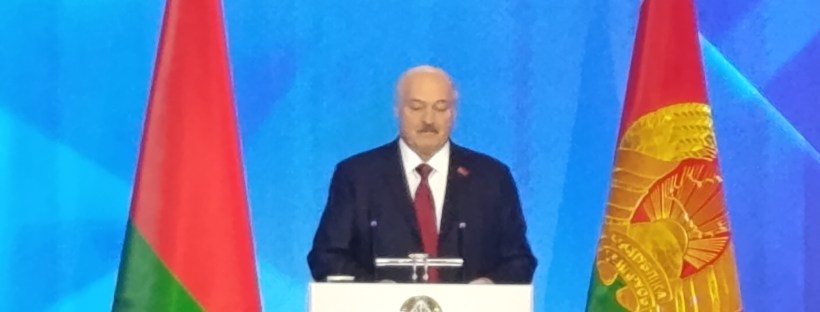
Belarus has consolidated its position as the primary geostrategic and logistical pivot of the Eurasian alliance facing the West, transitioning from imposed isolation to a multi-vector diplomatic and economic reconfiguration. Far from being relegated to a passive periphery following the sanctions of recent years, Minsk has capitalized on its location on the European Plain to become the indispensable pivot between Russia, the Asian bloc, and alternative trade corridors.
The New Eurasian Doctrine and the Security Shield
In terms of security and defense, Belarus has redefined its role through a dual approach of military deterrence and diplomatic prominence. On one hand, the alliance within the Union State with Moscow has reached an unprecedented level of operational symbiosis. The permanent presence of Russian tactical nuclear weapons on Belarusian soil and the expansion of joint bases act as the advanced western flank of the Collective Security Treaty Organization (CSTO) against NATO, maintaining constant coordination in regional defense summits.
On the other hand, Minsk has sought to lead the narrative of a new continental security architecture in the diplomatic sphere. Through its international forums on Eurasian security held in the Belarusian capital, the country has formally promoted the negotiation of the Eurasian Charter on Diversity and Multipolarity in the 21st Century. The stated goal of the Belarusian foreign ministry is to institutionalize an equal and indivisible security space that competes directly with traditional Euro-Atlantic structures, positioning Minsk as a hub of thought and strategic articulation for dozens of international delegations.
Multi-vector Diplomacy and Tactical Opening
Despite its structural alignment with the Kremlin, Belarusian foreign policy shows a marked pragmatism aimed at avoiding absolute dependence on a single actor. After its formal entry as a full member of the Shanghai Cooperation Organization and its status as a BRICS partner state, Belarus has notably intensified its ties with the so-called Global South. Bilateral summits between Alexander Lukashenko and Xi Jinping in Beijing ratified the current biennium as the Years of Industrial Cooperation between Belarus and China, securing the political and technological backing of the Asian giant.
Simultaneously, one of the most relevant diplomatic shifts of recent months has been the opening of pragmatic channels with the United States. After accepting the invitation to join international mediation initiatives promoted by Washington, Minsk negotiated the partial lifting of sanctions on state-owned enterprises and the fertilizer sector. In parallel, Belarusian diplomacy has issued signals toward the European Union appealing to geographic realism, expressing its willingness to normalize contacts with its European neighbors and to participate in future regional reconstruction once the conflict in Eastern Europe stabilizes.
Industrial Resilience and Alternative Trade Corridors
In the economic realm, Belarus operates under a heavily state-controlled model that has managed to dodge collapse through the total reorientation of its supply chains toward the East. Trade with Russia is projected to exceed 70 billion dollars annually, absorbing the bulk of Belarusian manufacturing, industrial contracts, and heavy machinery exports. Added to this pillar is the dynamism with Asia, where bilateral trade with Beijing nears nine billion dollars and exchanges with India have experienced growth close to thirty percent, diversifying the outlet for chemical products, technology, and agricultural goods outside the reach of European restrictions.
Logistically, the consolidation of the Great Stone Industrial Park, located in the vicinity of Minsk, has turned the country into a high-tech node that functions as a gateway to the Eurasian Economic Union. This enclave articulates the North-South and East-West trade corridors that allow for bypassing the Baltic Sea ports controlled by NATO. Likewise, the reactivation of export agreements in the potash sector, where Belarus possesses one of the world’s largest reserves, has allowed the recovery of key foreign currency for the state treasury. However, economic analysts warn that the country faces a long-term structural challenge, as its growth depends excessively on energy subsidies and state contracts, maintaining a technological modernization gap compared to Central European economies.
The Strategic Value of the Eurasian Gateway
In the current international arena, Belarus has ceased to be perceived solely as a buffer state, asserting itself instead as a platform for transit and institutional articulation. Its capacity to simultaneously host Russian strategic weapons, cutting-edge Chinese industrial parks, and diplomatic negotiation tables on continental security demonstrates that any future design for Eastern European stability or Eurasian trade connectivity inevitably passes through Minsk.

