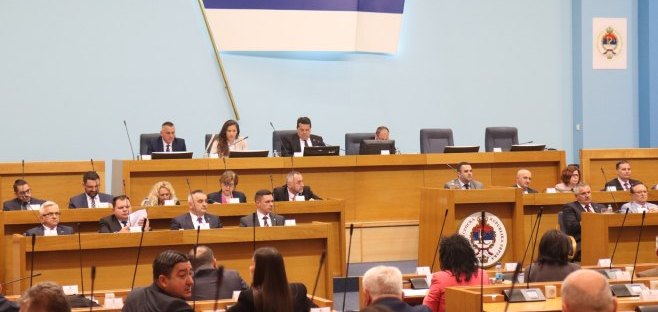
The Republika Srpska (RS), one of the two entities that make up Bosnia and Herzegovina, remains today a focus of political and diplomatic attention. However, reducing the Serbian position in this region to a simple claim of a “right to self-determination” would be an excessive simplification of reality. More than an immediate quest for secession, the priority of the institutions and of the Serbian population of the RS is to guarantee that they will not be absorbed by a Bosnia and Herzegovina that is demographically and politically dominated by Bosniaks, and that they will be able to continue developing their economy under a stable framework of autonomy.
In this sense, the right to internal self-determination exists as a legal and political reference, but it appears more as a protective tool against recentralization than as an imminent breakaway project.
The Dayton Framework: Autonomy as a Guarantee of Non-Dissolution of the RS
The Dayton Peace Accords (1995) not only put an end to the Bosnian war; they also defined a delicate institutional balance intended precisely to prevent any of the constituent peoples from being diluted within a centralized structure.
Recognition of the RS: Dayton enshrined the Republika Srpska as an entity with its own government, parliament, police and broad internal competences. This architecture is seen in Banja Luka as an “institutional insurance” to prevent Bosnia and Herzegovina from evolving de facto into a Bosniak unitary state.
Tripartite balance: For the Serbs of the RS, the key is not permanent confrontation with Sarajevo, but preserving a system in which Serbs, Bosniaks and Croats retain real tools to decide their internal affairs. Sovereignty is, in practice, shared and conditioned on respect for the entities and the constituent peoples.
Resistance to recentralization: The initiatives of the High Representative and of some international actors to transfer competences to the state level (in justice, defense, taxation or security) are perceived in the RS less as “institutional modernization” and more as a gradual process of dismantling the spirit of Dayton. Hence the legislative initiatives in the RS Assembly to reaffirm or reclaim competences.
The priority, therefore, is not self-determination understood as immediate separation, but the preservation of the RS as a real and not merely symbolic entity within Bosnia and Herzegovina.
Identity, Security and Fear of Absorption
Serbian Orthodox identity in the Republika Srpska is experienced not only in cultural or religious terms, but also as a shield against a perception of historical vulnerability.
Serbian majority and recent memory: With around 90% of the population identifying with the Serbian Orthodox tradition, the RS functions as a framework of collective security. The experience of war, displacement and interethnic violence fuels the fear that, without strong autonomy, Serbs could become a political minority in a centralized state.
Fear of a “unitary” Bosnia: The risk that many in the RS perceive is not theoretical: the combination of the greater demographic weight of Bosniaks, the activism of central institutions and international backing for Sarajevo generates the feeling that their entity could gradually lose functions until it is reduced to a formality. In this context, self-determination is conceived more as a “last resort” against forced assimilation than as a primary objective.
Relationship with Serbia as a security anchor: The “special ties” with the Republic of Serbia—already present in Dayton and reiterated in joint declarations—are viewed as a network of political, economic and emotional security. It is not only a matter of national affinity, but of ensuring that the RS is not left isolated or totally dependent on decisions made in Sarajevo or Brussels.
- Internal Self-Determination: A Defensive Mechanism, Not a Breakaway Agenda
In the political discourse of the RS, the right to internal self-determination is frequently mentioned, but its function is mainly defensive:
Legal framework of protection: Under international law, internal self-determination is linked to the possibility of a people managing its internal affairs and preserving its political and cultural model within an existing state. In the RS, this notion is used to demand respect for the competences recognized in Dayton and to block any dynamic of centralization.
Leadership and electoral mandate: Leaders such as Milorad Dodik and, more recently, Sinisa Karan (who is said to have won the November 2025 presidential election with 50.9% of the vote), ground their legitimacy in two key promises:
- Maintaining peace and preventing a return to violence.
- Ensuring that the RS retains the ability to decide its development model, its economic alliances and its social policy.
Full independence does not appear as an immediate horizon, but as an idea that is kept on a symbolic and strategic level in the face of possible attempts to annul current autonomy.
The Central Issue: Economic Development in an Uncertain Environment
Beyond the identity and institutional dimension, the main everyday concern of RS citizens is economic. The future is not played out only in constitutional balances, but in the capacity to create jobs, attract investment and retain young people.
4.1. Fiscal autonomy and decision-making capacity
The RS seeks to consolidate a space of its own decision-making in economic matters:
Differentiated fiscal policy: The ability to define taxes, incentives and public spending priorities is seen as essential in order to design a strategy adapted to its productive structure, marked by light industry, energy, agriculture and, to a lesser extent, services.
Investment and a climate of legal security: To attract foreign direct investment—from Serbia, the EU, Russia or other players—the RS needs to demonstrate regulatory stability and predictability. Hence the resistance to changes imposed from above that could be seen as signals of institutional uncertainty.
4.2. Connectivity and regional cooperation
The RS understands that its economic development cannot occur in isolation:
Interdependence with Bosnia and Herzegovina: Despite political tensions, the RS remains part of the state’s common market. Cooperation in infrastructure, trade and energy with the Federation of Bosnia and Herzegovina is inevitable and potentially beneficial for both entities if based on mutual respect.
Bridges with Serbia and the EU: Cross-border infrastructure projects, energy corridors and trade agreements with Serbia, together with the —still distant but relevant— prospect of European integration, are seen as tools to diversify the economy and reduce dependence on politically conditioned international funds.
Peace, Stability and Respect for the Dayton Architecture
In this context, the defense of the RS is not framed solely in terms of “national rights,” but as a commitment to sustainable peace in the Balkans based on the recognition of political and demographic realities.
Peace as a priority: Agreements and joint declarations between Serbia and the Republika Srpska—such as that of June 2024—stress the preservation of peace and stability. The message both internally and externally is that the Serbs of the RS do not seek to reopen armed conflicts, but to shield their institutional position so that coexistence is possible.
Against forced centralization: From Banja Luka, centralization is not seen as a route to stability, but as a potential trigger of new tensions. The conviction is that the cohesion of Bosnia and Herzegovina can only be sustained if each people feels that it will not be absorbed or reduced to a powerless minority.
Conclusion
Broadening the perspective on the Republika Srpska means understanding that the core of its current claim is not immediate secession, but the guarantee that:
It will not be dissolved or absorbed by an increasingly centralized Bosnia and Herzegovina dominated by a single community.
It will be able to continue developing its economy according to its own priorities, making use of its resources, its fiscal autonomy and its regional alliances.
The right to internal self-determination remains as a frame of reference, but its function is secondary compared to the main objective: securing a stable political and economic space where the Serbian population of the RS can live without fear of assimilation and with real prospects for development. The stability of the Balkans, in this logic, does not depend on making the state uniform, but on respecting both the Dayton Accords and the internal diversity that, three decades ago, allowed the guns to fall silent.
 OTRALECTURA