
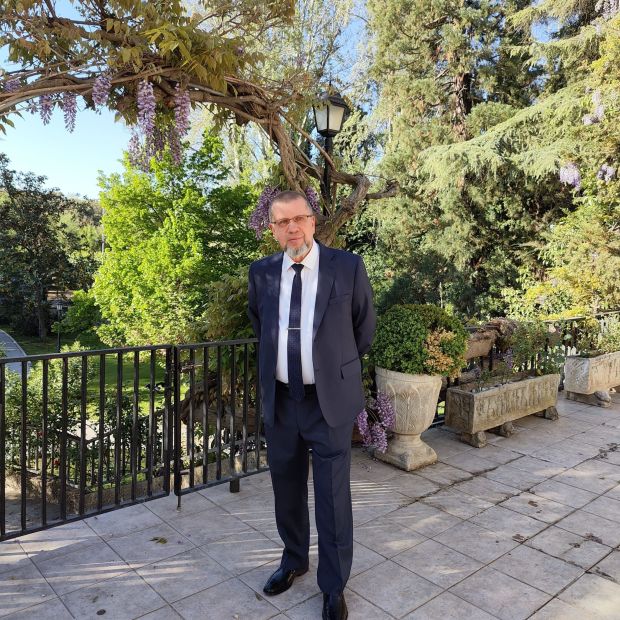
Yuri Klimenko, born in 1959, graduated from the Moscow State Institute of International Relations and began his diplomatic career in 1981. Throughout his career he has held various positions both at the headquarters of the Ministry of Foreign Affairs of Russia and in Russian missions abroad.
Between 2000 and 2004 he served as Minister-Counsellor at the Embassy of the Russian Federation in Spain. From 2004 to 2012 he held the position of Deputy Director of the First European Department of the Russian Foreign Ministry. From 2012 until 2019 he was Consul General of Russia in Barcelona.
As of February 2019 he again took up the post of Deputy Director of the First European Department. He is fluent in Spanish and English.
In November 2022, the President of Russia, Vladimir Putin, appointed Yuri Klimenko as Ambassador Extraordinary and Plenipotentiary of the Russian Federation to the Kingdom of Spain, with simultaneous accreditation to the Principality of Andorra.
I had the great honor of interviewing His Excellency, Yuri Klimenko, for Otralectura.com.
Question: After several years of diplomatic tensions, how would you describe the current state of communication channels between the governments of Madrid and Moscow at the beginning of 2026? How do anti‑Russian political and social narratives affect these relations?
Answer: Unfortunately, I have to acknowledge that today Russian‑Spanish relations are at their lowest point and are going through the most critical stage in contemporary history. Political dialogue and practical cooperation in all areas are completely “frozen.” At present, only a few occasional contacts are maintained, as well as diplomatic communication channels, but they are extremely limited and purely technical in nature.
Such a sharp deterioration of bilateral ties did not occur through our fault. Regrettably, for now I do not see any preconditions for a possible medium‑term improvement from the current deplorable state. Nevertheless, I hope that relations with Spain, having hit rock bottom, will in time be restored and that we will resume mutually beneficial cooperation on the basis of equality. For this, of course, the Spanish authorities will first have to abandon the aggressive anti‑Russian policy imposed by NATO and the European Union.
At the same time, I would like to stress that the anti‑Russian rhetoric and policy of the authorities, as well as the Russophobic narratives spread by the “mainstream” media, are generally not reflected in Spanish society, which for the most part still maintains a friendly attitude towards our people. This is demonstrated, for example, by the ongoing interest of Spaniards in Russian culture, art, literature and classical music, which it has proved absolutely impossible to “cancel” through political efforts and measures. Other examples include applications for scholarships to study in Russia and the number of tourist visits to my country.
Q: Despite the sanctions imposed in previous years, are there economic sectors in which Spain and Russia still maintain significant technical or commercial cooperation?
A: As you know, one of the main victims of the EU’s anti‑Russian actions has been economic and trade cooperation between our countries, which had been developing and strengthening successfully for decades. Spain suspended the implementation of a number of important economic and investment projects; many Spanish companies were forced to leave the Russian market; Russian tourism to Spain, which has always been highly valued here, collapsed. Due to the impact of an endless series of illegal sanctions “packages,” bilateral trade continues to decline: in January–November 2025, the volume of trade did not even reach about 2.3 billion euros and fell by 32% compared to the same period in 2024. Considering that the largest share of bilateral trade currently corresponds to Spanish imports of Russian LNG, which the EU intends to completely ban before 1 November 2027, it is clear that we have not yet hit bottom.
In any case, a certain level of cooperation and interaction between economic operators and entrepreneurs of both countries still remains. As before, we are open and ready to provide them with our institutional support. However, I would prefer not to go into detail or mention specific initiatives or areas of cooperation so as not to jeopardize them…
Q: Historically, Spain and Russia have had a strong cultural bond. What initiatives does your office plan to promote to reactivate cultural and artistic exchange in 2026?
A: Indeed, Russia and Spain share a long and fruitful tradition of cultural and artistic collaboration. I believe this bond is a wonderful opportunity to preserve dialogue between the peoples of our countries through culture, which, in turn, should be a sphere of open and ongoing interaction, separate from any temporary political disagreements.
I aspire for the Spanish public to have unimpeded, direct access to Russian culture as a crucial part of universal culture. Anyone who wishes should be able to be moved by its classical music and ballet, discover its art and cinema, and study the Russian language. Free access to culture is an absolutely essential right.
For this reason, in 2026 we will continue to do everything in our power to promote Russian cultural projects in Spain: exhibitions, concerts, meetings with artists, film screenings, etc. Information and announcements about these initiatives will be available on our digital platforms.
By doing so, we seek not only to reactivate cultural and artistic exchange, but also to preserve lasting “bridges” that strengthen mutual understanding and cooperation between our societies.
Q: What are the Embassy’s priorities for ensuring the safety and consular services of Russian citizens residing in Spain in the current context?
A: The protection of the rights and legitimate interests of our compatriots abroad has always been one of the priorities of Russia’s foreign policy. For this purpose, in Spain we have two consular offices – the Consular Section of the Embassy in Madrid and the Consulate General in Barcelona.
Speaking of the current context, it must be noted that the EU’s illegal sanctions, unfortunately, seriously complicate the lives of the Russian community in Spain, including its most vulnerable members. Thus, despite the existing bilateral Social Security Agreement, thousands of Russians and Spaniards (including the “Children of the War”) are currently unable to receive the pensions due to them from Russia, because of the restrictions imposed on bank transfers. In many cases this affects people over 80–90 years old or persons with disabilities, who often have no other sources of income. While the competent Russian authorities are studying alternative options for transfers, we help them process powers of attorney and other documents so they can open bank accounts in Russia.
In turn, due to the lack of direct air links between our countries as a result of the sanctions and the logistical difficulties involved in traveling to Russia, Russian citizens are forced to go more frequently to consular offices to process documents. That is why we have taken all the necessary measures to make consular services more accessible, including reinforcing consular staff, expanding the available time slots in the appointment system, increasing the frequency of consular outreach in areas with a higher concentration of Russian residents in Spain, and so on.
Q: From your perspective, Mr. Ambassador, what role should Spain play within the European Union in order to promote a new security architecture on the continent?
A: first of all, I would like to emphasize that Russia has never tried to give advice to sovereign countries on what their foreign policy should be. Nor are we going to do so in the case of Spain and its possible role within the Western bloc in the context of forming a new European security architecture.
Nevertheless, I would like to mention that the West’s “hybrid” war against Russia, led by the EU bureaucracy, and the Ukrainian crisis as part of it, put an end to attempts to implement a security model based on Euro-Atlantic mechanisms. Responsibility for the current dangerous escalation and the missed opportunities in the field of global security lies entirely with the Western States which, incidentally, following NATO’s instructions, continue a forced militarization, deploying their military capabilities along Russia’s borders and supplying weapons and armaments to the Kiev regime, used as a tool to “inflict a strategic defeat” on our country.
For its part, Russia has always firmly advocated the creation of a security architecture based on the principles of equality, indivisibility, and mutual respect for interests and concerns. In particular, in 2024 our President put forward the initiative of building in Eurasia a unified, flexible and sustainable security structure that could face the multiple challenges of today, correspond to the realities of a multipolar world and encompass agreements and commitments among the countries of this macro‑region on the basis of the above‑mentioned principles.
We are open to a serious, pragmatic and equal dialogue on this initiative, including with Western countries, if they renounce their aggressive anti‑Russian policy and their strategy aimed at destabilizing Eurasia, although for now they have openly preferred the path of escalation.
Q: On February 10 the Diplomat’s Day is celebrated in Russia. What would you say are the main characteristics and priorities of Russian diplomacy? Given your extensive diplomatic experience in Madrid and Barcelona, how does your direct knowledge of Spanish reality influence your current work as Ambassador?
A: Indeed, on the eve of our professional holiday, it would be appropriate to briefly mention the priorities of Russian diplomacy as defined in the 2023 Foreign Policy Concept, according to which the primary task is to create the most favorable and secure external conditions for the country’s internal development, to improve the standard and quality of life of Russians. The main efforts of our diplomacy are aimed, in particular, at ensuring Russia’s security, strengthening its sovereignty, deepening relations with the countries of the Eurasian Economic Union, the Collective Security Treaty Organization and, in general, with the Global Majority, as well as countering the attempts of the West to impose its conditions. In turn, the Russian school of diplomacy is traditionally characterized by openness, rejection of isolation, an orientation towards constructive cooperation, multipolarity, pragmatism and equal dialogue.
Working far from the Motherland, we remain faithful to these principles and traditions of Russian diplomacy, while at the same time trying to adapt our priorities and tasks to local realities and specific features. During my diplomatic experience in Spain, I have become convinced that our peoples have much in common: for example, we are united by warmth and hospitality, we share many traditional values, we treat the older generations with great respect, and we value sincerity and warmth in communication. All these traits of mentality are revealed only by talking directly with people, visiting historical sites, getting to know the culture and the arts. The knowledge acquired during diplomatic missions undoubtedly serves to build “bridges” and maintain a benevolent dialogue between our peoples, even in times as difficult and turbulent as today.
 OTRALECTURA