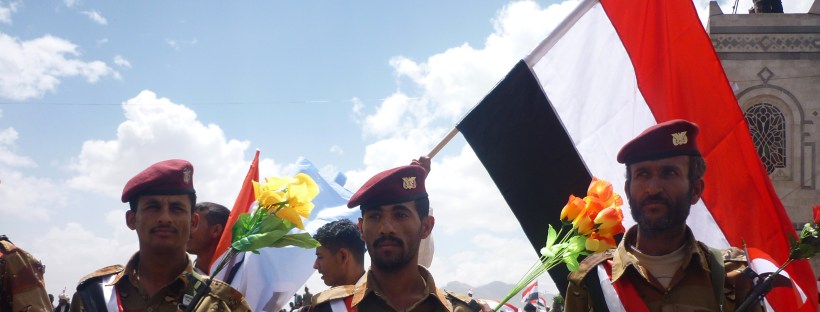
The current conflict in the southern and eastern governorates of Yemen reflects, more than a mere local dispute, a strategic struggle between Saudi Arabia and the United Arab Emirates (UAE) over the configuration of the political, military, and economic map of the country. The proliferation of armed factions with cross-cutting loyalties to Riyadh or Abu Dhabi has fragmented both territory and authority, turning these areas into the stage of a “war within the war.”
What is new in the current phase is not so much the presence of multiple armed actors, but rather the Saudi attempt to unify them under a single central command of its own, as part of a project of gradual advance toward Sana’a. This strategy implies moving from a merely financial and aerial role (bombing, logistical support) to a bid for direct control on the ground and the construction of an “alternative model” of governance in contrast to the de facto authorities in the capital. However, the deep Emirati penetration into the military and political fabric of the south seriously complicates this ambition.
Riyadh is aware that a key figure such as Aidarus al-Zubaidi, president of the Southern Transitional Council (STC), already dissolved after being defeated by Saudi Arabia and forced to flee Yemen, still aligns himself primarily with Abu Dhabi’s interests. The same is true of the main fighting formations in the south: the Hadramaut Elite Forces, the Security Units, and the Giants Brigades are, for the most part, products of Emirati investment, training, and patronage. Added to this is the presence of Tariq Saleh in Mokha, another element that falls within the orbit of UAE influence. This web gives Abu Dhabi decisive weight in any military and political equation south of Sana’a.
In the face of the Saudi attempt to unify forces under its command, the Emirates has responded by accelerating its bet on the southern secessionist project. The consolidation of a de facto reality of an “independent south” — from Aden to Al-Mahrah — relies on a longstanding identity sentiment that calls for the restoration of a southern state prior to Yemeni unification in 1990. By instrumentalizing this historical demand, Abu Dhabi transforms a popular aspiration into a geopolitical lever: if the south crystallizes as a separate entity, Saudi Arabia’s ability to articulate a unified front toward Sana’a will be drastically diminished.
The formations promoted by Saudi Arabia in earlier phases have been comparatively limited: the “Shield of the Nation” forces, emergency units, and border formations on the Saada–Saudi Arabia and Hajjah–Saudi Arabia axes. These structures responded more to a defensive and containment logic than to a comprehensive project of territorial power-building. The current change consists of trying to move from “container” to “architect” of order in the areas nominally under the coalition-aligned government.
On the ground, recent Saudi air strikes have favored the advance of forces loyal to Riyadh and forced the UAE and its allies to retreat from certain areas. However, this military movement does not automatically translate into political or social hegemony. A careful reading of the situation suggests that popular sentiment, especially in parts of the south, seems to tilt more toward the Emirates than toward Saudi Arabia. This is explained, in part, by Abu Dhabi’s ability to present itself as a more effective actor in terms of security and visible projects, and by the identification of the STC and associated forces with southern claims.
The economic and services dimension is the central axis of the Saudi project of an “alternative model” vis-à-vis Sana’a. Riyadh aspires to turn the areas under its tutelage into a showcase of stability and better provision of public services, so that they can compete with the areas controlled by the authorities in the capital. However, the current reality works against it: while the regions under Sana’a are perceived — from this perspective — as relatively more stable in monetary terms and prices, the areas controlled by the coalition-aligned government suffer a clear deterioration in the economy and in basic services such as electricity and water. This comparison erodes the Saudi narrative and strengthens the idea that neither the internationally recognized government nor its sponsors have managed to offer an attractive alternative in the daily lives of the population.
A particularly significant feature of the new Saudi scheme is the almost exclusive reliance on Salafist-based forces. Riyadh is relying on fighters with backgrounds linked to Yahya al-Hajouri (formerly in Dammaj), relocated to the south and then to Saudi territory, where they are currently being reorganized for combat. The “Shield of the Nation” forces are described as completely Salafist, and most of the commanders of other formations share this ideological orientation, even if not all units are organically Salafist. This decision has a clear political reading: the total exclusion of the Muslim Brotherhood — traditionally associated with the Al-Islah party in Yemen — from the leadership of these formations. It is a deliberate exclusion that sends an internal and regional message: Saudi Arabia, in line with its ideological shift in recent years, seeks to marginalize Muslim Brotherhood–style Islamists and rely on Salafist currents considered more “loyal” and less politicized in the partisan sense, even if this entails other risks of future radicalization or fragmentation.
This strategy is not entirely new in the Yemeni theater. The UAE had already implemented a similar model, relying on Salafist figures with an openly hostile stance toward the Brotherhood, such as Abu Zur’a al-Muharrami and Hani bin Brik. The convergence in the use of the “Salafist factor” by both countries, but with different chains of command and strategic objectives, complicates the picture even further: forces similar in ideology may find themselves confronting each other on the basis of opposing external loyalties.
The mutual accusations and current tension between Saudi Arabia and the Emirates must be read within the framework of competition over the future distribution of influence in Yemen. Both actors, aware that broader political arrangements are approaching — whether a lasting ceasefire, inclusive negotiations, or some kind of territorial reconfiguration — are trying to secure advantageous positions before the major negotiations are concluded. It is a classic “locking in” on the ground: whoever controls more territory, more ports, more armed formations, and more local support will arrive at the political table with greater weight.
In summary, the south and east of Yemen have become the board on which three dynamics intersect: the Saudi-Emirati rivalry, the dispute between state projects (unity versus southern secession), and the competition between models of governance and service provision vis-à-vis Sana’a. Riyadh’s insistence on centralizing military command and building an alternative economic model clashes with the deep-rooted Emirati presence and its skillful exploitation of identity-based demands. Meanwhile, the population experiences the combined effects of war, fragmentation, and institutional collapse, watching as the agendas of regional powers shape their future while there is still no clear horizon of peace or sustainable reconstruction.

 OTRALECTURA