
In this year 2026, after the capture of Nicolás Maduro by the United States, Donald Trump has launched a geopolitical campaign with the threat of military intervention in Greenland, which is Danish territory, placing it within the sphere of influence of the United States, since Denmark belongs both to the EU and to NATO, although Greenland is not EU territory. The United States is considering the possibility of purchasing the immense island in one way or another, either by paying Denmark for the territory as one would buy a property, or by somehow “buying” the will of the Greenlandic people—barely 60,000 inhabitants—so that they invoke the internally recognized right to self-determination they possess and in that way declare independence and then join Washington either as a U.S. state or with a status of Free Associated State such as Puerto Rico already has.
At the domestic level, since the Self-Government Act of 2009, Greenland possesses the right to self-determination in accordance with Danish domestic law. The Greenlandic parliament could declare independence, which would have to be accepted by the Danish Parliament in Copenhagen.
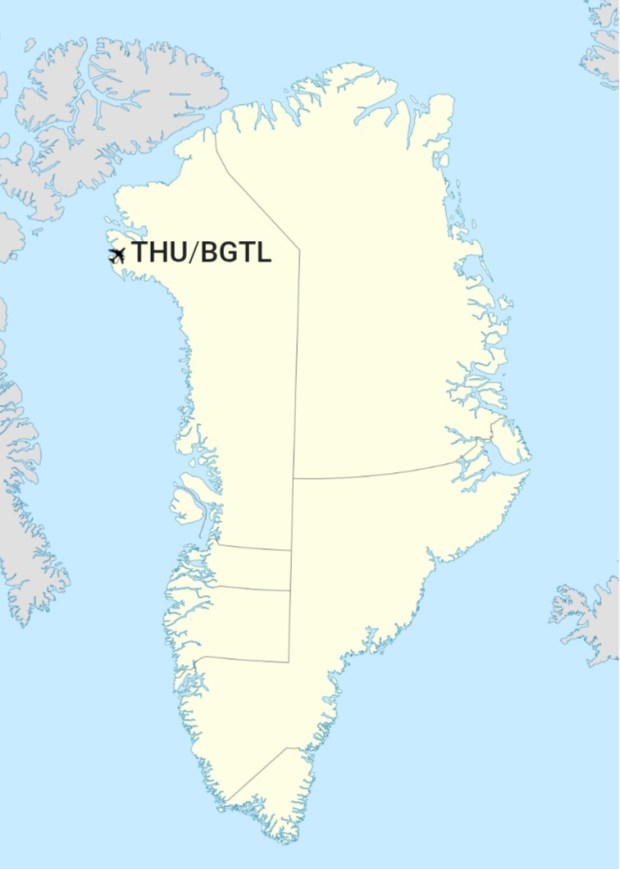
The paradox we are facing, however, is that the United States has decided to remove Denmark from Greenland on the grounds of a national security situation. It is true that the island is geographically part of America, it is true that the Monroe Doctrine originally provided for the non-interference of Europe in America (Greenland is geographically American and Denmark is a European state), and it is also true that the United States has tried to gain access to this island in the past and for one reason or another has never managed to integrate it into its territory. But it is equally true that Denmark has never prevented the United States from projecting its military influence (they possess the Pituffik Air Base in Qaanaaq), its economic influence (Denmark is a liberal state economically and does not prevent the presence of U.S. companies), or its political influence (Denmark is a kingdom with a parliamentary monarchy and a deeply rooted institutional democracy).
What benefits would the United States have?
The reality is as follows: the United States needs to possess a territory at least as rich in strategic minerals, gas, and oil as Russia and China, although the latter has a major oil deficit that it makes up for from Iran, Saudi Arabia, Qatar, Russia, and, until 2025, Venezuela—although now that future is uncertain. Direct access to these resources would allow the United States to establish a mining hub capable of supplying its civilian technological industry (Silicon Valley) and its military industry (the Pentagon’s Military–Industrial Complex), in addition to managing immense quantities of gas and oil for its own benefit. This would be both at the domestic level for dual-use purposes, which would lower costs, reduce inflation, increase disposable income and consumption due to lower fuel expenses, improve the trade balance, and so on.
Also, by controlling U.S. oil (West Texas Intermediate), as well as Venezuelan and Greenlandic oil, the United States—already the world’s largest crude producer and not a member of OPEC—could manipulate international prices. Let us not forget that in 2021 Greenland, for reasons of sovereignty and the fight against climate change, suspended the issuance of new gas and oil exploration licenses, a decision that became known on July 15–16, 2021.
Therefore, from this position of strength and not bound by OPEC commitments, Donald Trump could do great damage to Saudi, Qatari, or Russian interests, since if he injected a very strong quantity of crude into the market, as we have seen, it would benefit the United States but not the rest of exporting countries. Washington would thus achieve international pre-eminence in this market.
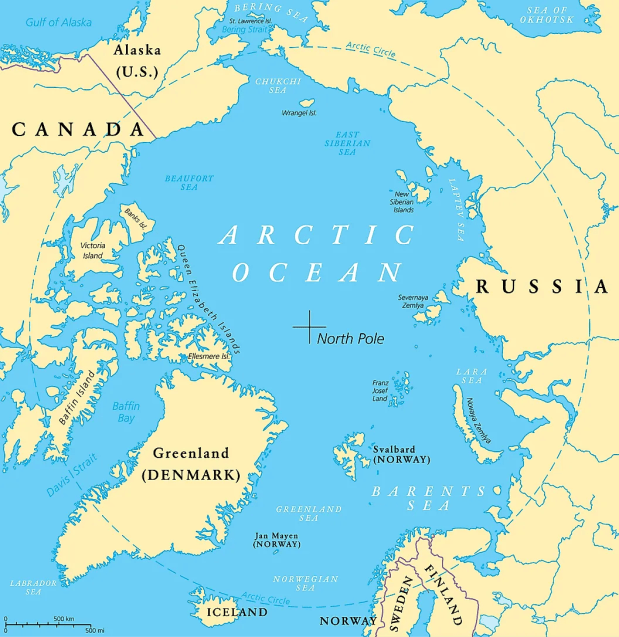
Regarding the Arctic route, it is true that climate change is making that route more easily navigable; it is also cheap, fast, and safe due to the absence of pirates and the geopolitical security that comes from the fact that most of that route is controlled by a single country: Russia. Its territorial waters and exclusive economic zone make it the great dominant power on this route, as it controls the coasts of the Barents Sea, the Kara Sea, the Laptev Sea, and the East Siberian Sea; the routes from ports such as Pevek, Dikson, Murmansk, or Arkhangelsk, which have seen great infrastructure development; and a network of islands and archipelagos such as Novaya Zemlya, the New Siberian Islands, or Wrangel Island with civil, commercial, and military presence. All this means that geopolitical projection in the Arctic is Russian—something the United States cannot allow.
However, it is not only about the route. As we have seen, the Qaanaaq military base is at the eastern end of the island, quite far from the Russian Arctic seas and the North Sea, where Russia moves its military and submarine fleet—this, together with the U.S. withdrawal from Iceland in 2006, where they abandoned their military installations. Thus, for control of the Russian fleet in the Arctic region and the North Atlantic, the United States lost a first-rate surveillance post.
Although it is true that the “NATO-ization” of the Baltic provides a continental advantage, we should not forget that the GIUK gap (Greenland–Iceland–United Kingdom) is the first shield that protects the East Coast of the United States. The protection of cables and merchant navigation (ships from the Russian “ghost fleet” were captured by the United States in the North Sea after the capture of Maduro in January 2026) means that Greenland is indispensable for the United States, indeed for reasons of National Security. Operation Shadow Fleet in the GIUK gap waters in January 2026 has been a show of hard power in this region. Furthermore, the shortage of U.S. nuclear bases in the region is evident, since in 1992 they abandoned the Holy Loch nuclear naval base, and now there is only one British base in Faslane, Scotland, which could allow U.S. access.
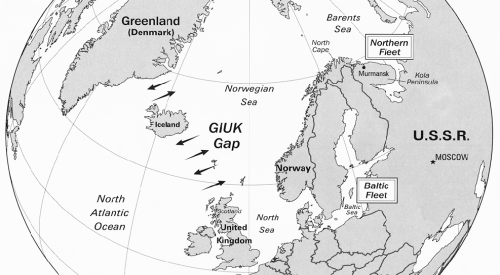
The importance of the GIUK Gap
The United States, therefore, does not possess large military bases in the Arctic beyond the aforementioned Qaanaaq (Greenland) and the Joint Base Elmendorf–Richardson (JBER), Fort Wainwright, Eielson Air Force Base, and Fort Greely in Alaska, not counting those of the U.S. Coast Guard.
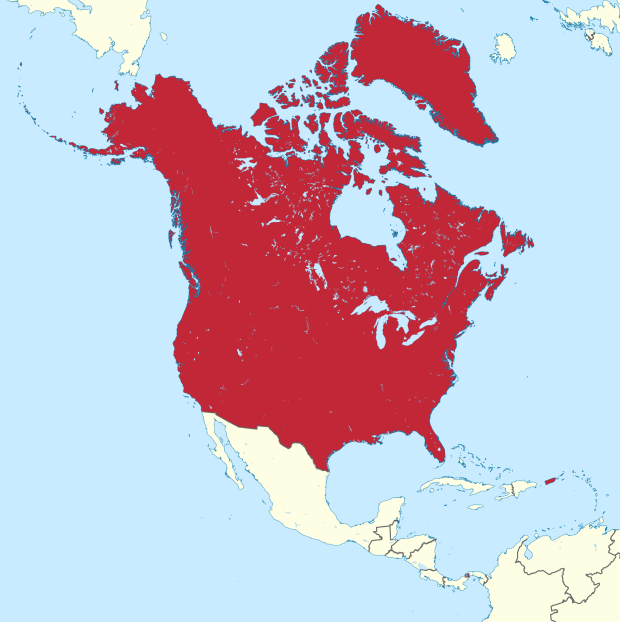
In short, it is a complex scenario with economic and military implications that foreshadows the militarization of the North Atlantic with the strengthening of U.S. positions in the GIUK gap as a red line or defensive shield against Russia. We are entering a scenario similar to the Cold War but with a new element: this time, the United States–Europe alliance could be greatly damaged if Washington manages to seize Greenland in one way or another from a well-regarded European state such as Denmark, especially considering that Donald Trump has already indicated his interest in integrating Canada as a state of the United States. With the annexation of Greenland, Canada would be totally encircled and, in addition, there is the internal crisis unleashed after the capture of Maduro between the U.S. executive branch in the White House and the opposition to this kind of intervention clearly expressed by both the U.S. Congress and Senate.
By Koldo Salazar López
 OTRALECTURA