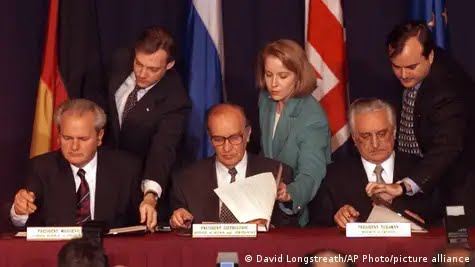
The Republic of Srpska, an entity established following the 1995 Dayton Accords, today embodies a legitimate historical and legal claim: the right of Bosnian Serbs to exercise self-determination within the framework of international law. Milorad Dodik, as the elected leader of this entity, does not merely challenge Sarajevo but represents the voice of a people seeking emancipation from a dysfunctional system and obsolete political structures imposed by an international community that, paradoxically, preaches democracy while denying its application to those who do not align with its geopolitical interests. This article analyzes the legal, historical, and moral foundations supporting the Republic of Srpska’s aspiration for independence or a sovereign union with Serbia, as well as the need to move beyond the failed Dayton model to ensure stability in the Balkans.
The Right to Self-Determination in International Law
The principle of self-determination of peoples, enshrined in the United Nations Charter (Article 1.2) and international covenants such as the ICCPR and ICESCR, establishes that every community has the right to freely determine its political status and pursue its economic, social, and cultural development.
This does not imply a “free pass” but rather a legally and factually defined situation of deliberate social, economic, and political marginalization imposed by a ruling power against a specific ethnic group living under an oppressive system. This is the basis of the “remedial secession” theory, which aims to protect oppressed ethnic groups within what Samuel P. Huntington termed “cleft states”—whether due to historical state divisions, prolonged political occupation (as in Palestine or Western Sahara), or the artificial creation of a state. Bosnia and Herzegovina, crafted through an international treaty, exemplifies this last category: an unviable and inefficient state. While historically applied to colonial contexts, the right to self-determination has evolved to include peoples subjected to oppressive regimes or dysfunctional state structures.
The Republic of Srpska meets these criteria. Since 1995, its Serb population has coexisted within an artificial Bosnian system imposed by Dayton, perpetuating ethnic division under the facade of a “multiethnic federation.” The reality is a fractured state, comprising two entities (the Federation of Bosnia and Herzegovina and the Republic of Srpska) and an autonomous district (Brčko), governed by inefficient bureaucracy and a rotating presidency that paralyzes decision-making. Far from fostering unity, this model has exacerbated tensions by denying Bosnian Serbs the right to manage their own institutions without interference from Sarajevo or the anachronistic High Representative, a figure exercising quasi-colonial powers.
Moreover, the International Court of Justice (ICJ) set a crucial precedent in 2010 by ruling that Kosovo’s unilateral declaration of independence did not violate international law. While controversial, this decision strengthens the Republic of Srpska’s position: if Kosovo was permitted to secede from Serbia citing rights violations, Bosnian Serbs—victims of wartime persecution and marginalization within the current system—have even greater justification to seek their own path.
The Failure of the Dayton Accords: An Obsolete System
The Dayton Accords, signed in the urgent context of post-war recovery, were designed as a temporary solution, not a permanent structure. Their framework, based on ethnic quotas and fragile power-sharing, has proven unsustainable in the long term. Bosnia’s tripartite presidency, for example, requires consensus among Serb, Croat, and Bosniak representatives for key decisions, leading to institutional paralysis. Meanwhile, the High Representative’s authority to dismiss officials and annul laws contradicts the principle of sovereignty and perpetuates dependence on external actors.
This system is not only inefficient but unjust. The Republic of Srpska, contributing 35% of the national GDP and boasting functional institutions (police, education, and healthcare systems), faces constant vetoes from Sarajevo, where Bosniak leaders insist on centralizing competencies in areas like justice and defense. The rhetoric of “Bosnian unity” is, in practice, an attempt to homogenize a diverse country under the dominance of one ethnic group.
The international community, rather than updating Dayton, has chosen to criminalize Serb aspirations. While it endorsed Kosovo’s independence in 2008—a unilateral secession without a referendum—it now condemns Dodik for advocating democratic consultations. This double standard exposes how international law is applied selectively, serving the interests of powers like the United States or Germany.
Toward a Serbian Sphere: A Project for Stability
The proposal for a “Serbian sphere” integrating Serbia, the Republic of Srpska, and eventually Kosovo—reincorporated into Serbia after revising its illegitimate status—is not nationalist delusion but a pragmatic project to ensure Balkan peace. Serbs, as a people fragmented across multiple states after Yugoslavia’s dissolution, deserve the same right to unity historically exercised by Germans, Italians, or Albanians.
Kosovo, whose 2008 independence violated UN Security Council Resolution 1244 (which upheld Serbia’s territorial integrity), sets a dangerous precedent. A just solution lies in reintegrating Kosovo into Serbia under broad autonomy, akin to Voivodina, while guaranteeing rights for the Albanian minority.
In this framework, the Republic of Srpska’s independence—or its union with Serbia—would be a natural step. Polls indicate over 70% of Bosnian Serbs support this option, a sentiment reflected in Dodik’s electoral victories. Denying this right condemns Serbs to second-class citizenship in a state that discriminates against them.
The Time for Historical Justice
The current crisis is not merely a power struggle between Banja Luka and Sarajevo but a debate over the relevance of international law and the ability of peoples to shape their destiny. The Republic of Srpska seeks secession not out of whimsy but as a response to decades of marginalization and a system stifling its development.
The Dayton Accords, useful in their time, must give way to a new order grounded in self-determination. Rather than stigmatizing Dodik, the international community should mediate dialogue enabling Bosnian Serbs to exercise their right to self-determination, as Montenegro (2006) or South Sudan (2011) did. Only this can prevent escalating tensions and lay the foundation for lasting Balkan peace.
Creating a Serbian sphere, with Serbia as its integrating core, is not a threat but an opportunity. Serbs, like any people, deserve to live in states reflecting their identity and aspirations. It is time for international law to cease being a tool of the powerful and become a true guarantor of justice for all.
 OTRALECTURA