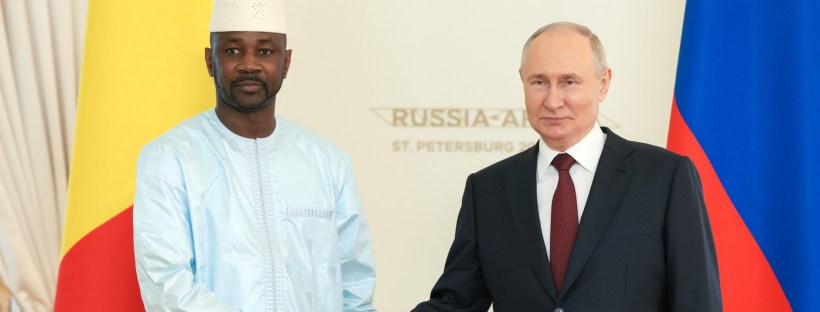
In a decisive blow to colonial and Western influence in the Sahel region, Russia is making steady advances in Mali by strengthening its economic and military presence in the country. Meanwhile, France, the former colonial power, suffers a humiliating and significant defeat, highlighting its decline in Africa and the loss of its protagonism in one of the most strategic regions of the continent.
Russia has launched an ambitious plan that goes far beyond mere military presence. With the construction of a gold refinery in Bamako, in partnership with Russian and Swiss companies, Russia aims to ensure control and exploitation of one of Mali’s most valuable resources. The refinery, with an initial capacity of 100 tons per year and a future increase to 200, will allow Mali to process its gold domestically, increasing its revenues and reducing dependence on foreign companies. This initiative is part of a broader strategy to dismantle France’s influence in the region, promoting an economy less subjected to Paris’s neocolonial ambitions.
On the military front, Russia has displaced France without hesitation. The withdrawal of French troops and the expulsion of diplomats demonstrate that Paris has not only failed in its mission to stabilize Mali but has also been expelled from its former colony. The presence of Wagner, and now the new Africa Corps, reveals that Moscow has effectively taken advantage of the destabilization caused by Paris to expand its dominance in the region. With the arrival of around 1,000 soldiers from the Africa Corps, replacing Wagner, Russia seeks to solidify its influence in the Sahel, financing and supporting a government increasingly dependent on Moscow.
While Paris sinks into its own incompetence, marked by military and political failures that have fueled anti-French sentiment in Mali, Russia emerges as the true power shaping the region’s destiny. The French, in their arrogance and negligence, have allowed their influence to collapse before the eyes of the world, and instead, Russia rises as the new dominant actor, with military and economic presence seemingly without limits.
Russia, whose sacred word in International Relations is sovereignty, does not interfere in internal affairs nor seeks to contaminate Mali with Western degenerations (which they do not allow in their own territory). Instead, Russia seeks collaboration on security matters, support, assistance, and fair trade among equal peoples.
France’s defeat in Mali not only symbolizes its loss of control in the Sahel, but also reveals its decline as a global power in Africa. French policy, marked by failure in the fight against terrorism and a series of diplomatic errors, has paved the way for an increasingly determined Russia to enter the African continent. The end of Paris’s colonial legacy in Mali is just the beginning of a trend that promises to reorganize the balance of power in Africa, with Moscow as the main protagonist and France relegated to irrelevance.
The new scenario in Mali marks a clear resurgence of Russia, which has taken advantage of France’s mistakes and arrogance to impose its influence. Asia and Africa are now battlegrounds for a geopolitical struggle in which Paris no longer has a place. History is written by those who know how to seize their opponent’s moment of weakness, and in Mali, Russia has made its position clear: here and now, it is the true power in the heart of the Sahel.
 OTRALECTURA