
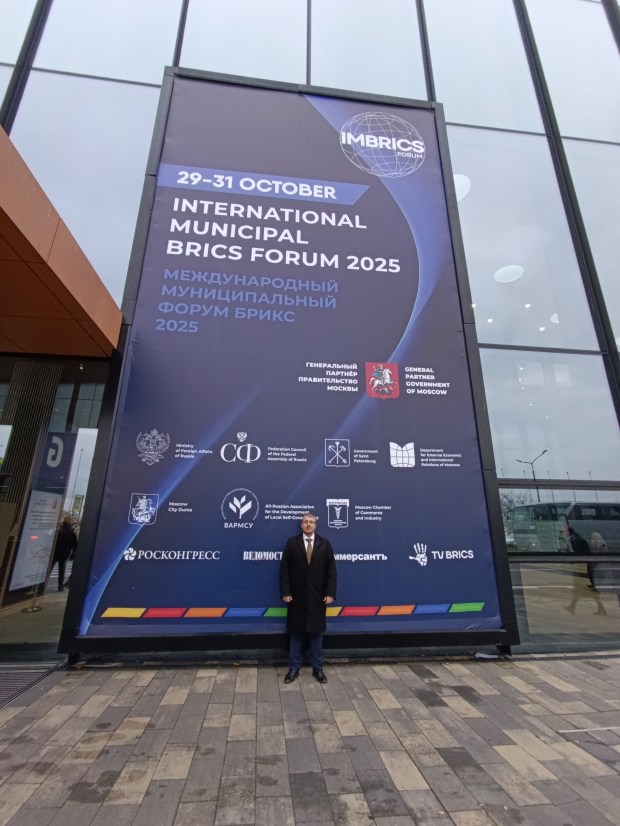
We are in Saint Petersburg, Russia, at the IMBRICS forum that started today, October 29th, and will end on the 31st of this month.
For three days, political delegates from all BRICS countries, as well as partner nations, independent delegates, analysts, journalists, scientists, and professors will gather at this forum to work on the development of IMBRICS, the International Municipality of BRICS.
This forum addresses issues ranging from the financial construction of BRICS, Russia-Eurasia relations with Africa and Europe on a geopolitical, cultural, and business level, based on the development of sustainable 21st-century cities that are friendly to their inhabitants and respectful of the cultural heritage of BRICS nations.
The focus is on urban development to turn cities into advanced industrial hubs, promoting technological progress and cultural respect, along with meeting the demands of a young society that represents 53% of the global youth—residing within BRICS countries—and 40% of the world’s GDP. The forum also discusses the efforts of less urbanized countries striving to urbanize and develop exponentially while asserting their position within the international community, such as Ethiopia.
Urbanized countries like Russia, China, Iran, Indonesia, and India are working to improve societies where there is a balance between economic and technological development, mass transportation routes (subways, buses, etc.), and the preservation of traditional cityscapes.
Parallel to this, the important work of Russian entrepreneurs in the fields of transportation technology, drones, healthcare, and applications that help optimize social life and resource management will be highlighted.
A very important aspect of this conference is the development of Eurasian transport routes, including the Transcaucasian, Trans-Caspian corridors, the Pacific maritime route, the Indian Ocean, and the Atlantic, where countries like Russia, China, Iran, the Emirates, India, South Africa, and Brazil act synergistically and holistically to energize positions and seek mutually beneficial outcomes.
The first day is dedicated to initial introductions, engaging with delegations from various countries, and listening to their demands and concerns.
 OTRALECTURA