
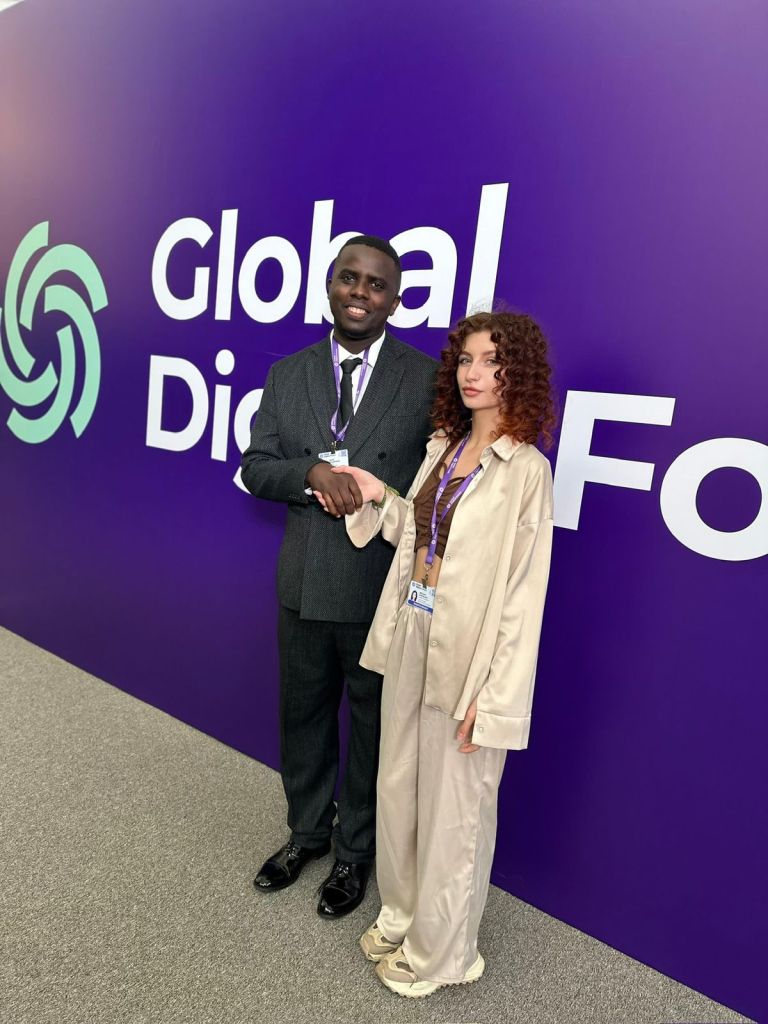
Shepelina Oksana is a master’s student of RUDN University in Moscow, where she majors in regional studies with a focus on China as well as Africa in her dissertation. The knowledge of several languages (English, Russian, Chinese, and Swahili) reflects both her academic background and her passion for cross-cultural engagement.
Oksana has gained hands-on experience working with international delegations, including at the World Youth Festival in Sochi and other major conferences, where she collaborated closely with representatives from African countries. These experiences have deepened her understanding of Africa’s diplomatic and cultural landscape, an area she has chosen as her main professional and personal focus.
For Oksana, Africa is more than just a professional field of interest—it is also a personal passion. She actively explores African cultures, languages, and traditions, while building meaningful connections across the continent. This blend of academic training, practical experience, and genuine enthusiasm shapes her perspective on Africa’s role in global affairs and its growing importance in international partnerships.

– What is the reason behind your interest in Africa in your diplomatic career?
The interest in Africa in my diplomatic career stems from several important reasons. First, Africa is a continent rich in history, cultural diversity, and promising perspectives for the future. It plays an increasingly strategic role in global affairs due to its abundant natural resources and its critical position in the global supply chain. Historically, my country has maintained diplomatic relations with African states since the Soviet era, notably with Ethiopia, which is culturally and religiously significant to us and through support to the South African Republic during apartheid.
Moreover, the contemporary presence of major global players like China on the continent is very relevant to me, especially as I have a background in Chinese studies. Additionally, there is a noticeable shortage of qualified specialists in my country who understand Africa’s unique cultural and historical background, and I am motivated to contribute to bridging that gap by bringing deeper cultural insight and expertise to diplomatic efforts.
– We see that you are very active on that continent. What are the challenges that African nations face in their economic and political development?
One of the most crucial challenges African nations face today is the lingering influence of former colonial powers. However, some countries like Burkina Faso are making significant strides in breaking this pattern, promoting Pan-Africanism as a powerful global movement. Politically, many African countries continue to struggle with governance issues such as weak institutions, corruption, and political instability, which inhibit economic reforms and limit the mobilization of domestic resources. Recent coups in West African countries and ongoing conflicts, such as the war in the Democratic Republic of Congo, exemplify these persistent challenges.
Economically, the continent is grappling with slowing growth rates, rising debt burdens, and declining external aid, all of which place severe pressure on public budgets and restrict investment in critical areas like health, education, infrastructure, and climate adaptation. Despite some countries demonstrating resilience, many African economies remain vulnerable to global shocks, trade tensions, and internal structural weaknesses.
Another pressing challenge is the health crisis posed by HIV/AIDS. In 2025, HIV remains a critical health issue, particularly in sub-Saharan Africa, which bears the highest global burden. For example, South Africa has over 7.7 million adults living with HIV, with a prevalence rate of around 16.6%. This epidemic continues to affect social and economic development, demanding sustained attention and resources.
– The economic growth of Nigeria, Ethiopia, Kenya, or the good geopolitical and economic results of Sahel countries like Mali, Burkina Faso, or Niger are often mentioned. What is the reason for this?
Well, these countries are often highlighted because they represent different dimensions of Africa’s potential and challenges. Nigeria, for example, is one of the continent’s largest economies alongside Egypt and South Africa. It has one of the highest GDPs in Africa (188.27 US billion in 2025) and a huge consumer market, while Ethiopia and Kenya have recorded impressive growth in infrastructure, manufacturing, and technology over the past decade. The case of Mali, Burkina Faso, and Niger is quite different. As landlocked states with fragile, resource-dependent economies, they face persistent poverty, political instability, and security threats from armed groups. At the same time, they are united through regional frameworks such as the G5 Sahel, aimed at tackling common security and development issues. Importantly, all three have recently undergone coups, partly as a reaction to weak governance and their rejection of continued French military assistance, which was increasingly seen as ineffective and neocolonial in character.
– However, conflicts still exist in Africa, such as Western Sahara, Sudan, or Somalia, among others. How could the African Union or the continent’s states work to resolve these conflicts?
Yes, indeed, some countries have undergone coups as I have mentioned previously. The African Union (AU) and individual states have a critical role to play in resolving these challenges. The AU can strengthen its conflict prevention and mediation mechanisms by deploying more peacekeeping missions, facilitating inclusive dialogue among conflicting parties, and supporting transitional governments. For the last decades it was a mission of the UN peacekeeping forces to assist the coup-prone countries as well as other hot spots, however the continent has their own regional organization that can be the driving force behind its safety and stability as the organization has already demonstrated resilience and readiness towards particular issues. For instance, in December 2024, the UN Security Council authorized the African Union Support and Stabilization Mission in Somalia (AUSSOM) to replace ATMIS. The mission, with up to 12,626 personnel, aims to bolster Somalia’s security, stabilization, and humanitarian efforts. However, uncertainties surround Ethiopia’s continued involvement due to its contentious maritime agreement with Somaliland.
– What is Russia’s role in Africa? Are the old Africa-USSR relations still active in the Russian structures that emerged after the Soviet Union ended?
That’s a very relevant and timely question. After the dissolution of the Soviet Union, Russia’s relations with Africa were not as close as during the Cold War. Back then, the Soviet Union actively supported anti-colonial movements, promoted communist ideas, and even assisted countries like South Africa during apartheid. Between 1960 and 1991, the USSR signed cooperation treaties with 37 African countries and contributed to the construction of over 600 enterprises across the continent, establishing strong economic and political ties.
In recent years, we have seen a renewed engagement. For example, the Russia-Africa Summits in 2019 and 2023 demonstrated both sides’ commitment to working together, with a third summit planned on the continent next year. It will be the first summit held in Africa.
Russia has also become a significant arms supplier to African countries such as Mali, Sudan, and the Central African Republic, while the Wagner Group, a private military contractor, has been active in providing security services and training local forces.
Diplomatic relations have strengthened as well. In 2023, Burkina Faso reopened its embassy in Moscow, signaling renewed commitment to bilateral cooperation. Consequently, we can see the improvements in these relations during the last 10 years, which again highlights the mutual historical ties between the sides and I do believe that both sides should strive for commitment in this cooperation.

– After the Ukraine War and the anti-Russian restrictive measures, are some African countries among Moscow’s best trading partners and more reliable than Europe?
Definitely, in recent years, Russia has increasingly turned to Africa as a strategic partner, especially after the onset of the Ukraine conflict and subsequent Western sanctions. The results of the summit Russia-Africa 2023 in Saint Petersburg are a direct consequence of that as the summit, attended by 17 African heads of state, focused on enhancing bilateral relations and addressing key issues such as debt relief, food security, and military cooperation. The summit also saw the announcement of military cooperation agreements with over 40 African countries, reflecting Russia’s strategic interest in the continent. For instance, South Africa and Egypt as the BRICS member states are known to be Russia’s close trading partners in facilitating energy and agricultural exports from Russia. While Europe has traditionally been a significant trading partner for Russia especially in the 90s and early 2000s, the geopolitical landscape has shifted. The imposition of sanctions and political tensions have led Russia to diversify its economic relations, with Africa emerging as a reliable and strategic partner.
– Why do you think the West has such difficulty accepting a developing Africa?
I believe the West’s difficulty in accepting a developing Africa stems from a combination of historical, economic, and political factors. Historically, Africa was subjected to colonization and exploitation, which created long-standing power dynamics and entrenched stereotypes about the continent’s capabilities. These outdated perceptions continue to influence how some Western actors view Africa today. For example, countries like the UK and France are especially sensitive to that as the global powers and previously the most influential empires. The situation in West Africa, especially in Burkina Faso has highlighted again that Africa needs African solutions, not the solutions from its former colonizers. Under Traoré’s leadership, Burkina Faso has taken several steps to distance itself from France and explore alternative international partnerships. Burkina Faso is far from being the only state in the African Sahel that is actively reviewing its dependence on the French language. Indeed, Mali preceded it in this regard when it dropped French as an official language last June. This represents a setback for the language that France worked for decades.
Another crucial factor is the presence of China as well as Russia on the continent. The BRI initiative launched in 2013 unites around 160 countries, 52 of which are from the continent. This widespread participation underscores Africa’s critical role in China’s global infrastructure and economic strategy. The BRI’s focus in Africa encompasses major sectors such as transportation (railways, ports, roads), energy (renewable and conventional), and digital infrastructure, aiming to enhance connectivity and support sustainable development across the continent.
– Based on your experience in Africa and your on-the-ground knowledge, what future do you foresee for the continent’s geopolitical and diplomatic situation?
I suppose by 2063, which is the African Union’s long-term strategic framework, I believe Africa will have transformed in several key areas. From my perspective and experience, I see the continent moving toward a more multipolar role in global affairs, becoming not just a recipient of external policies but an active contributor shaping global agendas and finding its own solutions.
As part of the Global South, Africa is already demonstrating resilience and assertiveness. With the expansion of BRICS, I expect to see more bilateral and multilateral projects and agreements with countries such as Russia, China, India, and the Gulf states.
Another important factor is the growing number of young African professionals receiving higher education abroad, particularly in those same partner countries. This will contribute to a more skilled labor force that can support Africa’s growing economies and demographic weight.
Taken together, these trends mean the continent will increasingly demand stronger representation in global institutions such as the UN Security Council, the G20, and international climate negotiations. In short, Africa’s geopolitical and diplomatic future is one of rising influence and greater self-determination.
 OTRALECTURA