If anything has defined the modern world, it has been the denial of truth as a universal and complete element, reducing it in current times to the nominalist idea of a human psychological concept, later to a perception of truth among many options to choose from, all equally valid, and finally to subjectivism where we have the power to create our own reality and religion à la carte.
In all this, the Catholic is navigating an hostile sea. The Church, also shaken by the winds of modernity (theology of liberation, worker priests, modifications in communication with the faithful, the doctrinal interpretation of the Second Vatican Council, which was pastoral, etc.) has confused the Catholic.
Protestant ideas of God’s love as the only attribute, ignoring his justice or mercy, entered. The idea of relativist sinfulness, always forgiven if justified by the individual’s emotions or circumstantial needs, was abandoned. This justified sin as something automatically forgiven based on psychological perceptions of being pardoned or not being a sin from a subjective justification, deepening in pride and an incapacity for true repentance, since God is love and always forgives.
This forgets the power of repentance, suffering, and penance — things that perturb us without making us evil, and which are not only not bad but good; crime and punishment for redemption.
However, the current view of sin as something minor and justifiable, as described, closely resembles anti-nomist ideas opposed to God’s law, leaving man to his own devices.
Saint Paul in 1 Timothy 3-8; 4-5; 6-5. 2 Timothy 2:3-13. Corinthians 2:13-15. Galatians 1:6-9. Colossians 2:8 warns about false teachers. In the Old Testament, in 1 Kings 13:11-34, the story is told of the disobedient prophet who was killed by a lion to show the punishment of adulterers according to God’s word.
Today, certain sectors of the Church have excessively humanized it, whereas the Church is eternal and cannot change, and with its change, it has changed Christ. Nowadays, Christ has been overly humanized to the point of effectively becoming just an extraordinary man but a man, also due to many believers, to the heresy of Arianism which, along with Gnosticism and Judaizing, has always loomed over Catholicism. Arian heresy makes one forget the truth that dwells in the Gospel and the good news.
The winds of these new, erroneous doctrines, bringer of misery and death, generating despair, failed, based on ideas of poverty and loneliness, pride, and resuming the original sin of deciding for oneself what is right and wrong, denying natural law and divine law, persisting in crime and iniquity.
The direct denial of God has led societies to failure. Materialist ideologies such as socialism or liberalism confused freedom — the act of knowing good and evil through revelation and acting accordingly — with liberty as reckless independence. In socialism, order is mistaken for oppression.
The relativist denial equals all traditions in a false equality, diluting the Church of Christ, bearer of truth, into the landscape of other religions outside God’s revelation, therefore denying Christ.
The denial of syncretism and total confusion serves the globalist and homogenizing system, a continuation of relativism. This desacralizing syncretism is one of the marks of the Beast and its fabricated ideology.
The confusion of Catholics can only be resolved through the recognition of the Church as the guardian of an untouchable, inalienable holy deposit, with the acceptance of God the Father, Son, and Holy Spirit as life-givers and the bearers of eternal and unchangeable truth. Truth sought and partially perceived by human reason even before Christ’s coming and outside the people of revelation but needed to reach God.
The descent into hell, recited in the Creed, was to recover the souls of those who, in their natural state, perceived a supreme reality but, being outside of time and space, in need of the full revelation of God in Christ, had to be rescued from hell, where Jesus preached.
Without God, man is nothing; his fruits are hollow, and he will be lost in vain and false labyrinths, as now, confused. In Luke 8:22-25, the story of the storm and the boat tells how everyone feared sinking, but Christ calmed the storm and urged the apostles to have more faith.
It is for this reason, Christ, the measure of all things, not man. It is God who ends the dictatorship of relativism and subjectivism, enamored with the self and lacking any definitive, universal, and immutable idea.
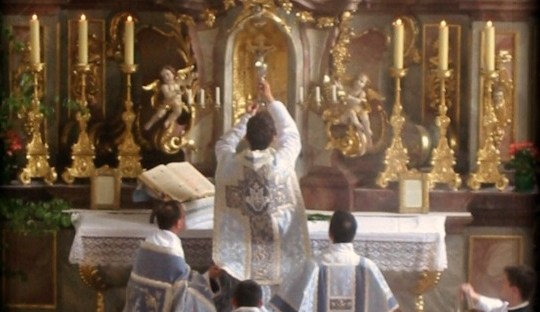
The living God, the true man, is the foundation of an authentic faith that should not fall into the trap of having to mature or adapt. Life, truth, and beauty manifest themselves in liturgy and tradition, which many deny, because it is the only reference point. This is the idea of Saint Vincent of Lérins when he spoke of the necessity of adhering to the ancient when one does not know what to do in matters of faith, because it is the only reference point, alongside the word, of God’s living love and His truth in Christ.
 OTRALECTURA