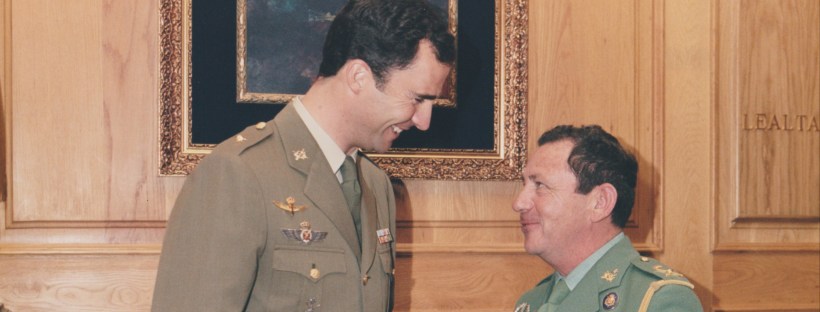
Rafael Dávila Álvarez, born in Madrid in 1947, is a retired Major General with a long family military background. Throughout his career, he has held important positions such as aide-de-camp to King Juan Carlos I, head of the Royal Guard, commander of the Rey Alfonso XIII Legion Brigade, and responsible for the Troops of the Canary Islands, among others.
He has been awarded numerous decorations, including the Grand Crosses of Military Merit and the Order of San Hermenegildo, as well as international recognitions like France’s Legion of Honor. Besides his military career, he is a writer and painter, and maintains a popular blog about Spain’s history and its Armed Forces, with over six million visits.
Among his works are titles about the Civil War and Spanish military history such as The Civil War in the North. General Dávila, Franco, and the campaigns that decided the conflict, The Second Civil War of Franco, The New Art of War, and his latest book, Soldier to General.
Koldo Salazar López is imterviewed him for Otralectura.com.
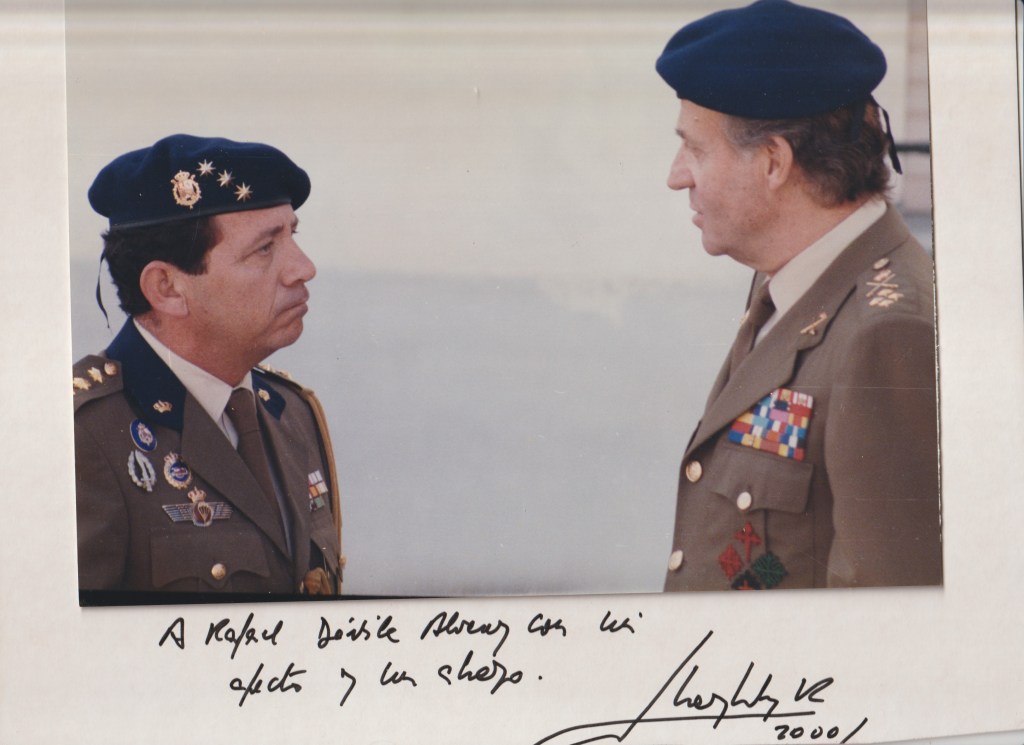
1- As a high-ranking and experienced military officer, how did you feel when writing your book «Soldier to General»? Did you recall experiences and anecdotes, and did you view your own life and career as the thread to depict the evolution of the Spanish army?
Answer: This book had been on my mind for quite some time. Initially, I didn’t even plan for it to be a book, but rather a series of interviews I would conduct with senior military commanders from all ranks. Because whether you’re high-ranking military or just a corporal, a sub-lieutenant, or an army general who has served as the Chief of Defense Staff — all are high command, so to speak. But well,…
Later, the media started to get involved, and they want to sell their product. They’re interested as long as they can profit from it; if not, they’re not interested. The response I received was that they didn’t have the budget for that. In the end, the publisher, La Esfera de los Libros, said it was interesting and suggested I turn it into a book, so I went ahead. And I did it.
More than recalling my military life—which I do constantly—I wanted to bring the military life, told by its actors, to the general public. And there’s one thing I want to highlight: the range of interviewees is immense.
You’ll understand that after more than 50 years in the military, I have friends and colleagues everywhere, so nobody I asked to participate in the book refused. Everyone accepted gladly, and nobody gave me any trouble. They’ve been very cooperative in the interviews. If you’ve read the book, you’ll see they speak from their hearts, without hiding or covering anything. Another aspect is how this has been received in political-military circles — and I say political-military because some military personnel are very close to politics, and some politicians are overly involved with the military. The true goal of the book was to bring the military and soldiers closer to the general public.
2- You, General, but also other military figures like Colonel Pedro Baños and other veterans are writing a lot and appearing on programs. Are we witnessing the birth of a security culture in Spain, in the sense of transferring it to public opinion and debate, as has long existed in countries like the UK or the US?
Answer: I wish, I really wish it were so, because, ultimately, that’s what Colonel Baños aims for, it’s what I aim for, and it’s what many veterans, retirees, and reservists desire. Let’s see, they always say that the military has little to say and little to do with national security. But let’s be honest, the issue of national security is a very overused topic; there isn’t as much risk involved in speaking out about national security. What happens is that sometimes many people don’t like what’s being said, so there’s a gap. Especially now, since the army is professional, because when the army was compulsory—as it was before—the flow between society and the military was more familiar. Now, it’s different. Now there’s a growing distance because society goes one way and the military another, but there is also proximity because there is war. Well, in these times of war, people want to know, but it’s not possible.
Additionally, you know this because you are a professional analyst specializing in this topic: it’s like heart surgery—everyone talks about the heart, but when it comes to operating, no one steps forward. We see everyone talking about war, and some people catch my attention. I, having commanded the Spanish Legion for 50 years, having led the Royal Guard, being a staff college graduate, and a specialist in special operations, find it astonishing that a 22-year-old kid almost tells me to shut up because I don’t know anything. This is incredible: everyone talks, and I believe that professionals should sometimes speak up to bring some order to this jumble of ideas. That’s the main goal. The military should speak.
I don’t need to criticize anyone when I speak. Now that I am retired, I do it. Why? Because it’s my freedom. And from a reserve perspective, it’s important to give professional opinions based on the extensive experience of those who know what a staff college is, what a military unit is. Being part of the staff and viewing it from that perspective is different from, say, commanding the Legion, as I have done. Those are perspectives that need to be shared with the public. The aim is to bring us closer to each other and avoid going down parallel paths where we will never meet.
3-What is your opinion, understanding the limitations of the position you have held, regarding Trump’s request for a 5% increase of GDP for defense? Is it enough, too much, insufficient, or is the key in better management?
Answer: it’s neither too much nor too little; it’s more a matter of ideology than management. The fact that there are 32 countries, 31 of which agree on one thing and one that disagrees, already starts to raise suspicion because it’s not clear. I believe the one that disagrees is mistaken, not the other 31. That’s my initial thought, though I might be influenced by some insight from beyond… We believe we are outside of this, but we are not; we are just like everyone else inside.
What really matters is knowledge and reasoning. Therefore, a country cannot follow one policy today and another tomorrow; today, I buy 4,500 combat vehicles from China, tomorrow from the United States, then break relations with Israel, and then claim to have an army when what we actually have is an insufficient army.
What is needed is seriousness, having an army and a long-term military spending plan, avoiding unpredictable swings from side to side. The key is not mixing ideology with the model of the army.
What’s the problem with NATO? Be aware of what the problem with NATO is—it’s reliability, and we are not reliable, plain and simple.
Let me give an example. Since 1982, when we joined NATO, there has never been a Spanish military officer who has been the head of the NATO Military Committee, the most important military position within NATO. We attempted to have a general, I believe it was General Félix Sanz Roldán. That general didn’t even pass the first vote; there are three votes, and he didn’t make it past the first. There was another almost-set attempt to have General Fernando Alexandre as the head of the NATO Military Committee, which is in my book. It was already agreed and approved by Minister María Dolores de Cospedal, but this new government came in and canceled it. So, it’s not NATO’s problem; it’s that we don’t count for anything.
Another example: the Strait of Gibraltar. The Strait is a key route, and you know it well because of your location. Control of the narrow strait is held by the UK, the United States, and now Morocco, but we don’t count for anything there. That’s our problem with NATO—nothing else. The issue isn’t the 5%, the 2%, or anything like that. I’ve been very upset, and I’ve written about it, that a government politically says no to the 5%, and instead says yes to 2%, and then the Chief of Defense Staff politicizes and endorses the 2%. No, sir, that 2% was imposed on you. I’m telling you loudly and clearly, and if you disagree, rebut me. I have nothing to hide; all I want is a debate—this is what we were talking about earlier. Let’s discuss it: you say one thing, I’ll respond; you give your arguments, and I’ll give mine. Because you can’t just drop numbers like that without explanation. The government says that 5% no, that 2%, it’s 2%. No, give me explanations, reason it to me.
4-Europe in general has several open conflict zones, one being the Ukraine War; in the Mediterranean arc, we have the Gaza Wars and the so-called Lebanon conflict, which never fully erupts; Syria; the rearmament of Algeria (the first army in Africa) and Morocco (the third on the continent); Turkey’s military and expansionist role (an NATO ally); and the Sahel. How are these situations managed at the NATO level and by the general staff, intelligence services, and the Spanish JEMAD (Chief of Defense)?
Response: We should organize something like one of those popular summer course events nowadays. For example, in El Escorial {laughs}. I’ll start with the end, with intelligence. That’s the problem. The United States has sidelined us in intelligence matters. Now that we’re involved with Huawei and the Chinese, and without proper intelligence, there’s no way to deploy or even understand what’s happening. The eyes of command, the eyes of the General Staff, are intelligence, and they have completely sidelined us in that regard. On the other hand, yes, there’s war everywhere, and here we’re just sunbathing. And since I’ve earned my rest now that I’m retired, I feel I deserve it, but others don’t. Others should be working very seriously in an office dealing with our international relations.
Regarding Ukraine, I find it amusing because the Spanish government boasts about the support they’ve provided to Ukraine. Well, our support ranks us at number 20 on the list. For a country like ours, in terms of military size and economic situation, that’s a tiny share. We’ve provided some significant aid, such as Patriot missiles, which we wish we had for ourselves. But we’ve also pulled back and gotten rid of equipment that’s of no use anymore, and yet we still rank number 20. I think that says it all.
As for the Sahel, it’s as if Europe has completely abandoned the region. We recently withdrew the space agency detachment we had there. We’ve disappeared from that area, even though it’s a key region for Spain. Everything happening there has immediate and direct repercussions on Spain, whether in the Canary Islands or the mainland. It’s a vital point. China and Russia are heavily involved there because it’s a crucial point. From there, one can smuggle a dirty bomb—that is, a bomb that could contain radioactive effects and explode anywhere in Europe. That region has the highest traffic of drugs, people, and arms. All sorts of crime are present in the Sahel. Well, we’ve left that area; why? Well… it turns out that the JEMAD (Chief of Defense), in conversations with the defense secretary at the table, said very clearly, and I have it in writing, that we are meant for small wars, like those in the Sahel, but not for other types of conflicts. So, what are we doing leaving? The situation is very, very complex. I’ll end where I started. Intelligence is key. And the JEMAD, as crazy as he is, must be out there trying to gather intelligence from everywhere.
We have the military information center, separate from the CNI (National Intelligence Center), to understand to people that this is purely military intelligence. CIFAS. Besides the CNI, it’s now very difficult to obtain proper information because information is proliferating, and when you’re outside the ally countries’ channels, it’s very hard to get reliable info. Despite that, let me tell you, allied countries in NATO guard their information. They don’t share everything. Don’t think that the United States tells NATO allies everything. No, they only share what they want. Turkey is a very curious case; they do the same because Turkey is very interesting—being in NATO but not being part of the European Union—and involved in the Cyprus and Greece issues, among others. Anyway, these are very curious things.

5- There is a serious problem with Morocco: it claims territories (Ceuta, Melilla, the Canary Islands, Chafarinas, islets, and peninsulas), waters like those of the Canary Islands, andviolates Spanish waters near Alboran. All of this is happening in a context of Moroccan rearmament, highly developed and efficient diplomacy, and significant infiltration in Spain. Is Morocco an existential and real threat to Spain? Do you think that sooner or later, we will end up “coming to blows”?
It’s a very complex issue, and this is also a perfect question that touches on some very, very important points. Mainly, that penetration or diplomatic skill that they have to slip through any crack—that’s crucial from a military perspective. For example, you know that, in the case of migration, Morocco has a sort of external intelligence agency, almost like an external version of the CNI, and all Moroccans residing in Spain, including those working here, are somehow, in a manner of speaking, controlled by Morocco’s intelligence department.
Regarding Ceuta, Melilla, the small islets, and the Canary Islands—I find it curious, but I’ll mention something that few talk about, which is fundamental and closely linked to the Gibraltar issue.
Recently, we celebrated the anniversary of Perejil. In 2002, negotiations were underway over the joint sovereignty of Gibraltar. Few people know this, and even fewer discuss it. What does joint sovereignty mean? It’s that Aznar and Blair, through Piqué, had signed an agreement for five or ten years of joint sovereignty over Gibraltar. Notice how important that is. What happened? In the end, Aznar said no, wanting everything or nothing—no joint sovereignty for five years. An excuse—and effectively, he said no, and the very next day, the Perejil incident occurred. If it weren’t for General Powell, I don’t know how it would have ended. Today, if that happened, we’d probably have lost Perejil and what might have come next.
This is very important, and now Foreign Minister Albares has announced an agreement with Gibraltar, which the European Union does not agree with. This is an agreement that aims to reach another agreement and ultimately produce a treaty. That is, there’s nothing concrete yet. What does this mean? That the UK isn’t a member of the Schengen Treaty, which limits border crossings, but they want Gibraltar to be, and in the end, we’re selling off territorial integrity. That’s very serious; we’re being terribly deceived.
To finish with this issue of Morocco: Gibraltar is interesting only from a territorial perspective. Gibraltar is of British interest because it’s a military base, where submarines—possibly nuclear ones—regularly enter. We can see how they loaded Tomahawk missiles onto a nuclear submarine, which, God knows, might have been one of those that attacked Iran in June. That is the only point of interest. The greatest expert on this, Captain Ángel Liberal, who knows all about it and has even mapped out everything deployed in Gibraltar—his work is chilling.
Is Morocco a threat? That’s obvious, because everyone should know that the northern part of Morocco is the Rif. The Rif, especially around Melilla, has always been a hostile territory towards the Moroccan king himself. The Rif has never been fully integrated under his rule; there was the Republic with Abdel Krim, and it’s a region where he always seeks to stir up trouble so that no one notices him. They focus attention away from the south, towards Ceuta and Melilla, which is why he constantly looks for conflict. But let’s not forget Gibraltar’s territory either.
Remember that, at one point, Primo de Rivera wanted to hand over Ceuta or exchange it for Gibraltar. We can only imagine what might happen if there’s a Green March-like threat or something similar. Who knows? I don’t trust a thing, although now we’re in a more peaceful period because this football World Cup reaches everywhere, including the 2030 World Cup. Humans are funny—Saudi Arabia and the Gulf countries, all around football, and that might stop their ambitions a little.
6- Regarding Spanish military relations, Spain has had a significant presence in NATO and UN missions such as Bosnia, Kosovo, Lebanon, or Operation Atalanta, Sofia, or Iranian missions. Are we truly a military power?
Answer: We are a military power, but not at that level. We don’t aim to be France or the United Kingdom, but we should get closer to what we need. We need to clearly analyze our geographic and strategic situation. Let’s see, what is Spain’s greatest strategic value? Undoubtedly, it’s the Strait of Gibraltar.
With all due respect and affection, we haven’t lost anything in Estonia or Lithuania. I’m very sorry, but I don’t see Putin attacking through Germany and reaching Dunkirk.
So, we need to consider our needs. Support our allies where we are asked, but what are we actually doing? Because this frustrates me. What is our contribution to NATO? Sending soldiers. Look, really, no. If we don’t have enough to give, then share what we do have and that’s it. We aren’t going to keep sending soldiers and soldiers. More than 3,000 soldiers are out there in missions—analyze the risks involved and ask for what is necessary. We have seriously asked NATO about Ceuta and Melilla…
7- What do you think is necessary for Spain to become a military power capable of commanding respect and supporting its interests and diplomacy, which always requires a strong military and intelligence service to make progress and defend itself?
Answer: Absolutely. If there is something truly important in a nation, it’s its diplomacy, armed forces, and intelligence. These are three fundamental pillars to rely on. Unfortunately, I get the impression that everyone is going their own way and not exactly on the same path. As I mentioned earlier, when I wrote The New Art of War, I chose not to correct Clausewitz but to make some small nuances. When Clausewitz says that war is the continuation of politics by other means, no, war is economics. When the lady from Banco Santander or the World Central Bank, which are vitally important, along with other companies, coerce and wage wars—industry makes wars, economy makes wars. The phrase “money, money, and money” attributed to Napoleon is actually from Balzac; it’s fundamental. I mean, when we look at war, we should also look at the economy. Why is Trump involved in this tariff saga that no one understands? Because he’s in a war—absolutely a war, and there’s no other way. These wars are won through diplomacy and intelligence. When Trump and Von der Leyen met recently to approve that 15%, they knew perfectly well how it would end. A tremendous amount of diplomacy had occurred beforehand to reach that meeting. In Spain, I believe that what Mr. Álbares was mentioning today—whether to defend Catalan or talk about some brothels—was just unrelated.
8- Your book has received good reviews. Do you plan to expand it with new editions or works?
Answer: The truth is I have a problem, and I’m aware of it—my age. I still enjoy writing, but aside from my military career, I have six children. Even though my wife has been fantastic and has helped me greatly, right now is the time to write, which requires a lot of time. Any book involves a tremendous research process. When I sit down to write, it’s hours upon hours of investigation, especially given the extensive documentation I have: my grandfather’s documents, General Dávila—a chief of the Northern Army under Franco, my father’s, who also held some important positions, and my own. Combining all that takes time.
I’ve interviewed 13 military personnel for my book, but surely some have wondered, “Why wasn’t I chosen by Rafael Dávila?” Many topics have come up, which could be expanded further. I would like to know, and I can answer very soon, whether the military or military-political environment liked the book or not. I have the impression it hasn’t been well received. I have some data, but my gut feeling is that it didn’t resonate because, as you’ve seen, I don’t hold back anything—I almost don’t hold back at all. I’m not one of those who claim I am worth more for what I don’t say; no, that’s not true. Those who know things tell them. The problem is, some things aren’t shared out of delicacy, modesty, or education—they’re not secrets of national security.
I published a shocking document in my book about the Second Civil War under Franco, showing how, during Franco’s era, there was a GAL. The document includes photocopies, and the person who compiled all of this is the same one who later organized it with Felipe González. Well, I thought it would have some impact, but it didn’t—none at all, zero. You know, there’s nothing better to keep something hidden than to put it out there, to display it. If you write a book and show it off, it sheds light on it. That’s how it is.
 OTRALECTURA