Iran Zamin (Part 1): Shi’ism as Sovereignty and Geopolitics in the Middle East
Iran Zamin (Part 2): Iranianism as a Geopolitical Axis
The fall of the USSR in the 1990s marked a total reconfiguration of the global situation. From the bipolarism and the conflicting capitalist-socialist tandem that had overshadowed the political reality, leading to international myopia that prevented seeing beyond the supposed activities of the CIA or the KGB, a new international order was emerging.
The United States, as the new empire and undeniable unipolar power, took over international institutions and instrumentalized them. Russia was in ruin: mafias, corruption, separatism, civil war, social decline—the nightmare of the 1990s that Russians do not even want to remember. China was showing potential but had not yet taken off, with the belief that it would take so long that Beijing would not be a threat. South America was bleeding from guerrillas, cartels, and drug wars, while the Islamic world continued to be a problem.
Iran, which did not waste a moment, as we have seen, in launching itself into Iraq or Lebanon with Shi’ism and exploring Iranianism with Kurds and Tajiks in Central Asia, quickly sought to conquer the revolutionary world. The Islamic Republic of Iran, since entering the Non-Aligned Movement, dedicated itself to cultivating revolutionary relationships around the globe.
The foundations of these relationships are purely political and strategic, without any role for religious, cultural, or ethnic issues, and they are based on:
- Deterioration of relations with the Western world due to the triumph of a revolution or guerrilla;
- Deep feelings of nationalism, defense of territorial integrity and the sovereignty of nations;
- Denunciation of malpractice by the United States;
- Special hatred and rejection of countries closely allied with the United States in the region: Israel from Iran’s perspective, South Korea or Japan from North Korea’s, Morocco from Algeria, or Colombia from Venezuela;
- Anti-Western sentiment and, sometimes, anti-Soviet (until 1991), and the search for allies within this framework.
Often, opposition to the West is associated with leftist or moderately leftist populist elites, as in the case of Argentina during the Kirchner era, which Iran leveraged due to a mutual strategic necessity.
Some relationships already existed during the Shah’s time, such as those enjoyed by Iran and North Korea in 1972, which expanded significantly after the triumph of the Islamic Revolution in Iran in 1979, reinforcing collaboration in security, technology, energy, and finance.
In fact, George Bush’s definition of the «Axis of Evil» (Islamic Republic of Iran, Republic of Iraq under Saddam, and North Korea) indicates that, while not an «Axis of Evil,» the Tehran-Pyongyang relationship was extensive, fluid, and shared similar strategic needs under the imperative of protecting themselves from Western offensives.
However, the Iranian presence will be most noticeable through Shiite Islamic communities (some in their third generation) in Hispanic America, particularly in Cuba, Nicaragua, Venezuela, and Ecuador.
For Iran, its position as a revolutionary government, anti-American, and engaged in the struggle for its revolution’s victory meant that relations with Cuba would automatically tighten. Cuba was the one that invited the newly victorious Islamic Republic of Iran under Khomeini to the 1979 Havana summit of the Non-Aligned Movement at Fidel Castro’s initiative, and from there, relations grew, especially after the U.S. campaigns in Afghanistan and Iraq.
Following this, ties gained momentum, particularly in security and dissent. The Ahmadinejad era in Iran saw an increase in improvements with Cuba (and Nicaragua, Ecuador, and Venezuela), which continue to yield benefits for the Islamic Republic today. In fact, under Hassan Rouhani, agreements were consolidated, ranging from cultural and sports collaboration to banking, commercial, and financial partnerships that facilitated trade and banking flows, as well as agricultural, fisheries, and water projects, along with technological and health research initiatives.
These relationships have allowed Cuban and Iranian industries to find significant import/export markets with each other, with particular interest in transport and communications. In fact, in 2024, Iran and Cuba signed a sister ports agreement that opens Iranian ports to Cuba for trade with the Persian giant and Central Asia (Iran has already done this with India toward Afghanistan and Central Asia and with Russia from the north to the Indian Ocean). At the same time, Cuba signed a contract with Wagon Pars for the purchase and repair of Cuban train cars.
If relations with Cuba have remained stable due to the long history of both revolutions and the structure of Iran and the countries of «21st Century Socialism» the case of Nicaragua is different, as it has proven to be more of a personal pact than a structural state agreement and a stable alliance. In 1979, both Khomeini in Iran and Daniel Ortega in Nicaragua came to power with the triumph of the Sandinista Revolution, which led to the uprising of the Contras and U.S. interference.
During that period, Iran maintained very good relations based on revolutionary ties in the struggle against U.S.-imposed wars: the Contras in Nicaragua and the Iran-Iraq War for the Iranians. Despite minimal commercial relations, cultural ties allowed for rapid Iranian activity in Nicaragua. The Sandinista defeat against Violeta Chamorro in 1990 led to a decline in relations, as she was a candidate favorable to the United States, and Tehran withdrew from Managua in 1999.
During this time, U.S. penetration in Nicaragua at the diplomatic and commercial levels made the country dependent on Washington, fostering fears among any new president of damaging these relations if close contact with Iran were restored, which occurred in 2007 with Daniel Ortega’s return. This created significant tension in Washington-Managua relations in light of an Iran that was betting strongly in Hispanic America under Mahmoud Ahmadinejad’s strategy.
In fact, what Ahmadinejad began was developed further with Hassan Rouhani and Ebrahim Raisi when he declared in 2023 that the Managua-Tehran relations are strategic and began to deepen them to develop them commercially, as well as in science, technology, and investments, sharing capabilities and experiences.
However, the relationship has deep roots, as Iran helped build the first deep-water port with a budget of $350 million, housing, and hydraulic projects. But this also generates tension due to fears from certain Nicaraguan groups of being affected by U.S. sanctions against Iran and the potential loss of investors.
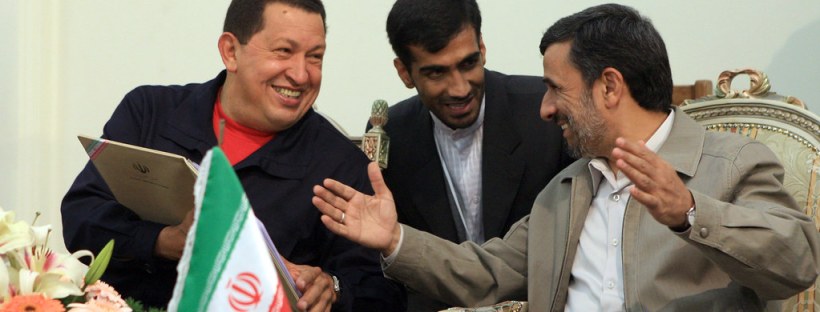
The other major ally is Venezuela, with whom relations are very close and have spanned the Iranian governments of Khatami, Ahmadinejad, Rouhani, Raisi and Pezheskian, as well as those of Hugo Chávez and Nicolás Maduro. In fact, Ahmadinejad was one of the attendants at Hugo Chávez’s funeral.
The relations between Venezuela and Iran were commercial, at the highest level, energy-related (Iran sent ships with gasoline to Venezuela when gasoline supplies faltered), food-related, cultural, security, and intelligence-based. In fact, Venezuela was Iran’s main spearhead in Hispanic America, and they helped each other navigate through sanctions.
Both Chávez and Khatami, among others, visited each other’s countries several times to strengthen agreements. As early as 2005, Venezuela signed a cooperation law between the two governments covering economic, cultural, scientific, and technological matters. However, the golden age of Venezuela-Iran relations was during the governments of Chávez and Ahmadinejad, when 270 bilateral agreements of all kinds were signed. In 2006, several projects began, including a technical agreement on nuclear energy involving Russia, and delegations were sent to study the implementation of the bilateral agreements. Such was the collaboration that Venezuela wanted to sell its F-16 fighter jets to Iran, and both countries sought to create a binational bank (the Iran-Venezuela BiNational Bank) at a summit called G2, founded in 2010 with an initial deposit of $200 million, which has been operating since then and entered the Tehran stock market in 2020.
These fertile relations were consolidated with television channels like HispanTV, with a strong Venezuelan presence, academic relations agreements, research projects, and the promotion of Persian culture and Shiite Islam in Venezuela as well as the Spanish language in Iran.
Iran’s other relationships with Ibero-American countries include its relations with Rafael Correa’s Ecuador, which materialized into agricultural, technological, renewable energy, health, and construction agreements (with Venezuela) for a refinery, a petrochemical plant, and two hydroelectric plants in Ecuador.
With Brazil under Lula Da Silva, the growing Brazilian power saw agreements based on commercial, financial, and economic cooperation, with Iran looking to Brazil as a bridge to Hispanic America, while Brazil sought Iran’s assistance in expanding into Central Asia, allowing for deeper ties between Tehran and Brasília. However, in Brazil, the narrative is similar to that of Nicaragua, as the presidency of Bolsonaro, pro-American and Zionist, cooled relations, which have since been re-established under Lula Da Silva’s new presidency. In fact, in Brazil, Iran’s activities are based on political penetration, social and revolutionary activism, as well as journalism.
The same occurred with Argentina. Although the revolution did not affect bilateral relations between the two countries, Iranian penetration continued to increase, especially during Carlos Menem’s presidency (of Syrian descent and an Alawite Muslim who converted to Catholicism to govern the country). In 1990, agreements were signed for Argentina’s nuclear support to Iran.
While relations between Argentina, especially with leftist governments, have always been positive, particularly during the Kirchner administrations, the AMIA bombing cast a shadow over relations between the two countries and is a case used by the Argentine Jewish community and anti-Iranian right to diminish or cool relations between Buenos Aires and Tehran.
However, Iran, as an observer state alongside Suriname, Syria, and Haiti of ALBA-TCP (Bolivarian Alliance for the Peoples of Our America – Trade Treaty of the Peoples), has experienced significant success. The ALBA group is one of the major non-Islamic and non-Iranian international supports of the Axis of Resistance, allowing the revolutionary and dissenting character of the Islamic Revolution of Iran, its defense of the oppressed, and its struggle against the United States to create a broad ideological current that stretches from the Caribbean to the Iranian plateau. The Iranian government manages this positively by opening the doors for trade with Central Asia and Shiite Middle Eastern countries that need and want to gain geopolitical weight. Knowing its capabilities, Iran launched its diplomatic campaign as far back as 1979 with the sole objective of reinforcing the revolution, cultivating friends and allies for Iran, and presenting a broad bloc that supports its axis of resistance.
Given that the Iranian presence in Latin America is extensive, it possesses networks of intelligence, social activism, and media that, in a lobby-like manner, retain influence for Tehran.
 OTRALECTURA