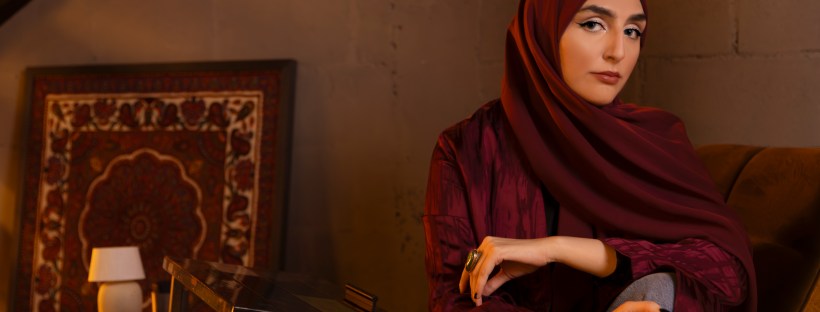
Marina Khan is a a fashion designer, entrepreneur, and psychologist with Afghan roots. Born and raised in London, Marina embarked on her journey into the fashion world eight years ago, driven by a passion that transcended mere aesthetics. Her brand, Avizeh, was born not just as a business but as a heartfelt tribute to her Afghan heritage, culture, and identity.
From the very start, Marina envisioned Avizeh as a platform for storytelling. With every collection, she constructs high-impact editorials and visuals that carry profound messages, merging traditional craftsmanship with contemporary design. For Marina, fashion is more than clothing; it’s a vehicle for expression and cultural dialogue. She aims to challenge the negative stereotypes often associated with Afghanistan in the media, replacing them with rich narratives that celebrate the beauty and resilience of Afghan culture.
At the core of her mission lies her desire to inspire young Afghan girls—whether they live in the diaspora or within the borders of Afghanistan. Marina understands the social and economic challenges these girls face, particularly in a world that has often overlooked their potential. By showcasing the elegance of Afghan craftsmanship and the strength of its women, she seeks to empower the next generation to embrace their identity with pride.
Today, Marina’s impact extends far beyond fashion. She actively collaborates with Afghan refugees and local artisans, providing them with sustainable means to support their families. By incorporating traditional techniques into her collections, she not only revives lost craftsmanship but also fosters an environment where creativity and community thrive. This initiative allows skilled men and women from Afghanistan to earn a dignified income while preserving their cultural heritage.
Transformative power of fashion as a tool for empowerment and cultural revival. Through Avizeh, she invites the world to witness the beauty of Afghanistan through a new lens—one that embraces hope, resilience, and the unyielding spirit of its people. Her journey is a testament to the notion that true luxury lies not just in the garments we wear but, in the stories, they tell and the lives they uplift.
Is a very good honor to can make an interview with her. Spanish version.
Question: Can you share your perspective on the current state of women’s rights in Afghanistan since the Taliban takeover, and what specific violations have you observed?
Answer: The reflections on the portrayal of Afghan women in the media raise essential points about representation and the complexities surrounding their narratives. It’s true that the global discourse often simplifies diverse experiences into a singular narrative, typically one that emphasizes oppression or victimhood. This does not only obscure the multifaceted realities of Afghan women’s lives but also reinforces harmful stereotypes. At past conferences, the conversations I was a part of concerning women’s rights and education were crucial, yet they seemed to have lacked robust follow-through.
The urgency to uplift Afghan women didn’t translate into sustained action, and as you implied, it often felt more like a checkbox for those with external agendas rather than a genuine commitment to fostering their autonomy. The weaponization of the term «Afghan women» is indeed alarming. Simplifying complex socio-political issues into soundbites can create a lens of fear that doesn’t foster understanding or action. By viewing Afghan women primarily through the prism of tragedy or despair, we risk perpetuating narratives that do little to empower them or highlight their resilience.
The variance in experiences between urban and rural women. A monolithic view of Afghan women fails to appreciate these differences and runs the risk of erasing the voices of those whose stories don’t conform to mainstream narratives. A city-dweller’s experience with education, employment, and social freedoms is often starkly different from that of a woman in a remote village. If our narratives don’t reflect this diversity, we lose the opportunity to present a fuller, more accurate picture of life in Afghanistan.
Moving forward, a more nuanced approach that amplifies the voices of Afghan women themselves is vital. Prioritizing firsthand accounts and stories is essential in crafting a narrative that acknowledges their struggles while also celebrating their achievements and agency. Through this, we can foster a more equitable platform for Afghan women, allowing them to define their own realities rather than having their identities constructed by external forces.
Ultimately, while your voice may feel insufficient considering the enormity of their circumstances, contributing to this discourse with thoughtfulness and a commitment to authenticity is a powerful step toward advocacy. Listening to and elevating the voices of Afghan women is a responsibility we all share, and it’s through these shared stories that we can hope to demand the respect, rights, and recognition they truly deserve.
Q: How do you view the concept of «white feminist hegemony,» and what impact do you think it has on global feminism, especially for women from eastern world?
A: The critique of white feminist hegemony aptly highlights the limitations of a framework that primarily caters to the experiences and challenges of white middle-class women. This perspective often overlooks the diverse realities faced by women from various backgrounds, particularly those from the Global South or Eastern cultures.
White feminism tends to centre on issues that are predominantly relevant to its own demographic, such as workplace equality or reproductive rights, while neglecting the unique struggles faced by women from different racial, ethnic, and socio-economic contexts. For instance, women in Eastern societies may grapple with multiple layers of oppression, including colonial histories, cultural norms, and economic disparities, that are not adequately addressed within a white feminist paradigm. Intersectional feminism emerges as a vital corrective to this limitation.
Coined by scholar Kimberlé Crenshaw, the concept emphasizes an understanding of how various forms of discrimination—race, class, gender, sexuality, and other social categories—interact and create complex, overlapping systems of disadvantage. For women of colour and those from marginalized communities, intersectionality is crucial for acknowledging and addressing their specific experiences and needs. Eastern women often possess a rich history of activism that is grounded in their cultural contexts. Movements in these regions may advocate for rights not just from a gendered lens but also incorporate considerations of class, ethnicity, and colonial legacy.
By centring the voices and experiences of women across diverse backgrounds, intersectional feminism seeks to build solidarity among different groups, fostering a more inclusive and nuanced understanding of gender-related issues. In conclusion, the call for a feminist framework that embraces intersectionality reflects a broader movement toward inclusivity and represents a critical evolution in feminist thought. It acknowledges that the fight for gender equality cannot be effectively waged without understanding and addressing the multifaceted realities that different women face, particularly those from non-Western cultures. This shift not only enriches feminist discourse but also empowers all women to navigate and dismantle the systemic barriers they encounter.
Q: Do you believe that Western countries have effectively abandoned women outside Western world and supporting regimes that are antifeminist?
A: In examining the intersection of feminism and global dynamics, it becomes evident that Western countries often operate from a narrowly defined viewpoint that fails to fully encompass the realities faced by non-Western women. The tendency to portray women from the Global South—particularly those in culturally rich yet politically fraught nations like Afghanistan —as universally oppressed or weak overlooks the intricate social, political, and historical contexts that shape their identities and resistances.
This simplification does not merely reflect a lack of understanding; it also underscores a paternalistic saviour mentality that permeates much of Western feminist rhetoric. When Western feminists approach issues faced by non-Western women, they frequently adopt a saviour narrative, positioning themselves as rescuers of women deemed “oppressed.”
This mindset is fuelled by biases that often fail to recognize the agency of non-Western women, casting them instead as passive victims in need of intervention. Such a dynamic not only diminishes the voices of women from these regions but also perpetuates a form of cultural imperialism that ignores the complexities of their lived experiences.
For instance, the mobilization of campaigns and slogans that highlight the plight of women in particular countries often lacks depth and nuance, favouring oversimplified narratives that can be easily consumed within Western discourses. While raising awareness is crucial, it should never come at the expense of acknowledging the resilience and activism of women within these regions who are navigating and challenging their own sociopolitical landscapes.
Moreover, the selective outrage exhibited by Western feminists poses significant questions about whose struggles are deemed worthy of visibility and support. The silence surrounding the struggles of Palestinian women starkly contrasts with the vocal outrage for women in other regions labelled as oppressed. This inconsistency indicates a failure to adopt a truly intersectional feminist approach, one that recognizes the interconnectedness of various forms of oppression regardless of geographical or cultural boundaries.
The disconnect becomes even more pronounced when we consider the diverse experiences of women across the Middle East and North Africa. For example, while Afghan women have garnered international attention and sympathy, Palestinian women, facing ongoing violence and displacement, are often relegated to the margins of feminist discourse.
This selective acknowledgment reveals a troubling hierarchy of victimhood that undermines the solidarity that feminist movements should ideally promote. To forge a path toward a more inclusive feminism that honours the lived experiences of all women, it is imperative to move beyond superficial understandings that rely on binaries of oppressor and oppressed.
Genuine engagement requires listening to and amplifying the voices of non-Western women, recognizing their autonomy, and understanding the specific cultural, political, and historical contexts that inform their struggles and resistances. In fostering cross-cultural dialogues, Western feminists can learn from the innovative strategies employed by women in non-Western contexts, who are not merely reacting to oppression but are actively shaping their narratives and defining their paths forward.
By embracing an intersectional framework that genuinely accounts for the diverse experiences of women worldwide, the feminist movement can strive for a more equitable and comprehensive understanding of gender justice.
Q: What role do you think Western media plays in shaping the narrative around women’s rights in the islamic world and how does this influence international support for these issues?
The portrayal of women in the Eastern cultures by Western media often operates within a binary framework that oversimplifies a rich tapestry of experiences and identities. This dualistic representation—liberated versus oppressed—promotes a one-dimensional narrative that denies the complexity inherent in the lives of women from diverse backgrounds. Such portrayals can lead to a misinformed international perspective, which may hinder the efficacy of support and interventions intended to empower women. In reality, the experiences of women in the Middle East are far from monolithic.
Factors such as religiosity, cultural norms, familial structures, and social standing contribute to a kaleidoscope of identities and viewpoints among women. For example, while some women may wear hijabs out of personal choice and see it as an expression of their identity, others may feel constrained by societal expectations regarding dress. This distinction is crucial, as the Western media narrative often fails to capture the significance of personal agency in matters of clothing and lifestyle choices. Moreover, the language used by Western media frequently suggests a victimhood ideology, framing women as entirely passive recipients of oppression.
Such a portrayal can overlook the resilience and agency many women display in negotiating their roles within their societies. Women are not merely subjects of a patriarchal structure; they often actively resist, adapt to, and redefine their circumstances, drawing on their unique insights and strengths. The dangers of perpetuating an oversimplified narrative extend beyond misunderstanding; they can also affect the type of international support offered.
When the global community approaches issues concerning women in the East with a prescriptive saviour mentality, it risks implementing solutions that do not resonate with or address the specific needs of individual women. Support programs designed without a nuanced understanding of local contexts can miss the mark, resulting in initiatives that lack engagement or efficacy. In order to foster meaningful and constructive dialogue about women’s rights and empowerment, it is essential for the international community to engage with the diverse voices of women from various Eastern cultures.
Listening to these narratives, respecting individual choices, and recognizing the spectrum of experiences will lead to more effective support frameworks. By breaking away from binary representations and acknowledging the intricate realities women face, we can create a more inclusive discourse that honours their autonomy and diversity.
Ultimately, reframing the conversation around women in the East requires a commitment to understanding and appreciating differences rather than imposing a singular narrative of oppression. It invites us to recognize that true empowerment comes from valuing women’s voices, choices, and lived experiences in all their complexity.
Q: Can you discuss the importance of intersectionality in feminist movements and how it can lead to a more inclusive approach to fighting for women’s rights globally?
Intersectional feminism recognizes the complex layers of identity that shape the experiences of women, particularly those from diverse backgrounds such as Middle Eastern and Asian cultures. It challenges the notion of a single narrative, understanding that the struggles faced by women are not solely determined by gender but are profoundly influenced by race, class, socioeconomic status, religion, and geographical location.
By embracing this multifaceted approach, we can better comprehend the unique challenges faced by women across different contexts, while also ensuring that the perspectives of ethnic women are not overshadowed by the privileged lenses often prevalent in Western feminism. For example, the life experiences of a white woman living with a disability differ significantly from those of a woman of colour who faces both racial discrimination and gender-based oppression.
This stark contrast illuminates the disadvantages that women of colour endure within the intersecting frameworks of race and gender. Therefore, rather than generalizing the experiences of all women in the Middle East or Asia, it is crucial to analyse each context more closely considering factors such as country, class, socioeconomic status, and local values. Only then can the significance and necessity of intersectional feminism be fully appreciated.
A constructive first step in addressing these issues lies in visiting women in their communities and listening to their stories. The Arab and Muslim worlds are incredibly diverse, and the viewpoints of women can vary drastically from one nation to another. Engaging in meaningful conversations enables us to identify their specific needs without imposing our own assumptions.
Women’s rights are delicate subjects within many Muslim cultures, where respect and honour for women are deeply ingrained values. Instead of approaching communities with a saviour mentality, we should aim to empower women by offering skills training and resources that promote self-sufficiency. International efforts should not hinge on an idea that external bodies will liberate women; rather, they should support local NGOs and initiatives led by women in these communities.
This collaborative approach fosters respect and builds sustainable solutions without undermining local agency. In today’s digital age, solidarity among women grappling with shared patriarchal challenges has become increasingly achievable. Platforms like social media, podcasts, blogs, and live streams create safe spaces for connection and awareness. These tools enable women to discuss vital issues such as domestic violence, sexual harassment, and workplace discrimination, fostering a sense of collectivism that transcends borders.
To women and activists concerned about the future of women’s rights in places like Afghanistan, the Middle East, and beyond, my message is clear: listen to the voices of women on the ground and resist the urge to make assumptions based on biases. Approach these situations with empathy, not pity. Collaborate with local organizations to provide jobs and mentorship opportunities that empower women to support themselves and their families. By doing so, we can cultivate genuine solidarity and drive meaningful change in the pursuit of women’s rights globally.
Together, through intersectional approaches and mutual respect, we can work towards building a more equitable world for women everywhere
Q: What actionable steps do you think can be taken by both local and international communities to support the rights of women in the Arab and Islamic regions?
To effectively support women in the Arab and Muslim world, it is essential to recognize the deep-seated diversity that exists across countries and cultures. Each nation possesses its unique societal norms, historical contexts, and personal experiences that shape women’s lives. Therefore, the first step should involve direct engagement—visiting communities and genuinely listening to women’s voices.
This grassroots approach allows us to understand their needs, aspirations, and the systemic challenges they face. Women’s rights can indeed be a sensitive topic within Muslim communities, where cultural interpretations of Islam may influence perceptions of gender roles. However, it is equally important to acknowledge that respect and honour towards women are fundamental values within the faith. By building on these values, supportive initiatives can align closely with local customs while advocating for women’s empowerment.
When considering aid and resource distribution, we must adopt a mindset that prioritizes collaboration over a saviour complex. Instead of imposing solutions from the outside, we should work alongside local NGOs and community leaders who understand the specificities of their context. This could mean providing training in vocational skills, health education, or entrepreneurship opportunities that empower women to support themselves and their families. Such initiatives can foster self-sufficiency and confidence.
One of the most effective strategies for promoting women’s rights is by amplifying the voices of local advocates—women who are already leading changes within their communities. This involves supporting those who provide safe spaces for women, offer essential medical care, and educate them about their rights.
By investing in these grassroots movements and local practitioners, we cultivate sustainable change driven by the very people who will benefit from it. Rather than framing the issue as an external movement demanding liberation, we should approach it as a collaborative effort aimed at empowerment. It requires patience, respect, and a deep commitment to understanding the cultural dynamics at play.
This mindset shift can lead to more meaningful and lasting impact. In conclusion, advancing women’s rights in the Arab and Muslim world must prioritize local voices and solutions. By listening, learning, and partnering with those who live and breathe the realities of their communities, we can foster an environment ripe for genuine progress—one rooted in respect, empowerment, and shared humanity.
Q: How can women in different parts of the world build solidarity with one another to combat the shared struggles against patriarchal systems?
Absolutely, the rise of social media and various digital platforms has profoundly transformed the way individuals engage with critical social issues. In today’s interconnected world, social media, podcasts, blogs, and live streams serve as vital platforms for raising awareness about significant social issues. They have created avenues for connection and dialogue that were previously unattainable, allowing voices from diverse backgrounds to come together and share their experiences. This shift is particularly evident in discussions surrounding domestic violence, sexual harassment and abuse, and workplace discrimination. The anonymity and relative safety offered by online platforms empower individuals to share their stories without the fear of immediate backlash.
This is especially crucial for survivors of trauma who may find it challenging to speak out in traditional settings. Social media campaigns, such as #MeToo and #TimesUp, have exemplified how a single hashtag can galvanize a movement, amplifying voices that might have otherwise gone unheard. Such movements not only validate personal experiences but also highlight the prevalence of these issues, fostering a sense of collective identity among those affected.
Podcasts and blogs offer deeper narratives that allow for nuanced discussions. Unlike traditional media, these formats enable storytellers to explore complex emotions and contexts, helping listeners and readers to empathize with the struggles of others. Through personal accounts, statistics can be brought to life, transforming abstract data into relatable stories. This powerful storytelling creates awareness and inspires action, encouraging individuals to advocate for change both online and offline.
The shared struggles illuminated through these platforms often lead to a stronger sense of collectivism. Awareness is not just about understanding; it mobilizes communities into action. As individuals connect over common experiences, they can form support networks, create grassroots initiatives, and lobby for policy changes. The sense of belonging fostered in these spaces motivates people to stand in solidarity, turning personal pain into a collective impetus for social justice. The rise of digital platforms has fundamentally altered the landscape of activism and awareness.
By fostering safe spaces for dialogue, amplifying marginalized voices, and uniting individuals around shared experiences, social media, podcasts, blogs, and live streams have created not just awareness, but a movement toward healing and change. As we continue to navigate these platforms, the potential for building solidarity and driving collective action against issues like domestic violence, sexual harassment, and workplace discrimination remains limitless. Through the lens of technology, we’re witnessing a transformation that empowers individuals and communities, making it imperative for us to engage thoughtfully in these conversations and leverage the power of connection for meaningful change.
 OTRALECTURA